A Luftwaffe Junkers Ju 87 dive bomber damaged while taking off from a field airstrip and later inspected by ground personnel during World War II.
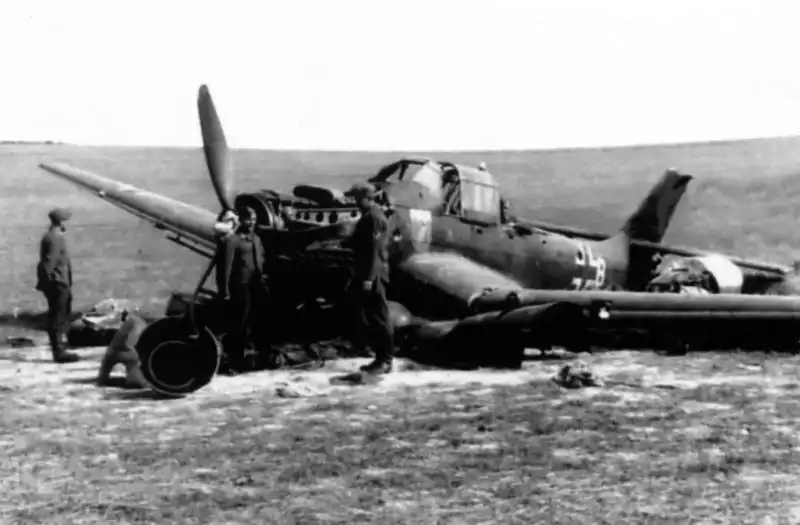
This wartime photograph shows a Junkers Ju 87 Stuka of 1./Schlachtgeschwader 77 (SG 77) after it was damaged while attempting to take off from a forward airfield. The aircraft is being examined by Luftwaffe technical personnel, providing a rare glimpse into the recovery and assessment procedures that followed operational losses.
The Ju 87 Stuka
The Junkers Ju 87 was Germany's best-known dive bomber and one of the defining aircraft of the early years of World War II. Designed for precision attacks against ground targets, it combined steep dive capability with remarkable bombing accuracy.
Its characteristic features included:
- Fixed landing gear.
- Automatic dive recovery system.
- Dive brakes for controlled steep attacks.
- Excellent bombing accuracy against tactical targets.
Although highly effective during the early campaigns of the war, the Ju 87 became increasingly vulnerable as Allied and Soviet fighter forces expanded and improved.
Aircraft Losses During Takeoff
Takeoff was among the most hazardous phases of any combat flight. An aircraft accelerating along a runway had little room to maneuver and was particularly vulnerable to enemy fighters, artillery fire, or mechanical failures.
According to the available information, this Ju 87 was damaged while attempting to leave its forward airfield. The exact circumstances remain unknown, but the aircraft was rendered incapable of continuing the mission.
The Role of Ground Crews
The photograph captures Luftwaffe maintenance personnel inspecting the damaged aircraft. Ground crews were responsible not only for servicing aircraft but also for evaluating battle damage, determining whether repairs were feasible, and salvaging usable equipment from machines that could not be returned to service.
Their work was an essential but often overlooked part of wartime aviation operations.
What the Photograph Shows
- A disabled Junkers Ju 87 at a forward airfield.
- Inspection by Luftwaffe technical personnel.
- Damage sustained during takeoff.
- The logistical side of frontline aviation rather than aerial combat.
Instead of depicting combat in the air, the image records the immediate aftermath of an operational loss on the ground.
Historical Significance
Photographs such as this demonstrate that combat aircraft faced danger throughout every stage of a mission. Mechanical problems, enemy attacks on airfields, and accidents during takeoff or landing accounted for a significant proportion of wartime aircraft losses.
The image also highlights the importance of maintenance personnel, whose efforts determined whether damaged aircraft could return to service or had to be written off.
Photo Information
- Aircraft: Junkers Ju 87 Stuka.
- Unit: 1./Schlachtgeschwader 77.
- Location: Unknown.
- Date: Unknown.
Recommended Literature
- Peter C. Smith — Junkers Ju 87 Stuka.
- Manfred Griehl — Junkers Ju 87.
- Alfred Price — The Luftwaffe Handbook.
- John Weal — Stuka Units of World War II.
This photograph documents an often-overlooked aspect of military aviation: aircraft losses occurring before a mission had even begun. It illustrates both the vulnerability of combat aircraft during takeoff and the crucial work performed by ground crews responsible for inspecting, repairing, or recovering damaged machines.