105mm leFH18 field howitzer crew preparing to fire during World War II. The leFH18 became the standard light field howitzer and one of the most widely used artillery pieces of the Wehrmacht.
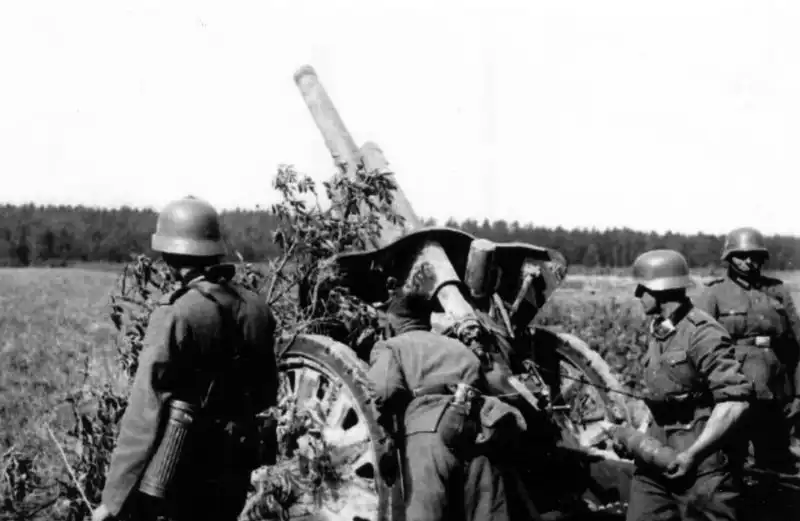
This wartime photograph shows the crew of a 10.5 cm leFH18 (leichte Feldhaubitze 18), the standard light field howitzer of the Wehrmacht during World War II. Rather than being a spectacular "wonder weapon," the leFH18 became one of Germany's most important artillery systems thanks to its reliability, versatility, and ability to provide continuous fire support for frontline troops.
The Standard German Field Howitzer
Adopted before the outbreak of the war, the leFH18 equipped nearly every German infantry division. It formed the backbone of divisional artillery throughout the conflict and was employed in every major theater where German forces fought.
Its principal missions included:
- neutralizing enemy artillery and machine-gun positions;
- destroying field fortifications;
- supporting infantry attacks and defensive operations;
- delivering indirect fire against troop concentrations.
Unlike heavy artillery, the leFH18 usually operated relatively close to the front line, allowing it to respond quickly to requests from forward observers.
The Gun Crew
Operating a field howitzer required close teamwork. A typical crew included the gun commander, layer, loader, fuse setter, and several ammunition handlers. Every member had a specific task, allowing the gun to maintain a steady rate of fire under combat conditions.
Effective artillery depended not only on the weapon itself but also on the experience and coordination of its crew.
Fire Support on the Battlefield
The leFH18 served throughout the war, from the campaigns in Poland and France to the fighting on the Eastern Front, in Italy, and in Western Europe.
Although later Allied artillery generally offered greater range and, in some cases, higher rates of fire, the German howitzer remained a dependable and effective weapon until the final months of the conflict.
What the Photograph Shows
This image documents:
- a Wehrmacht 105 mm leFH18 field howitzer in firing position;
- the coordinated work of an artillery crew;
- the practical realities of frontline artillery service;
- one of the most common German artillery weapons of World War II.
Rather than focusing on dramatic combat, the photograph illustrates the routine work that sustained artillery support day after day.
Historical Significance
Artillery inflicted a large proportion of battlefield casualties during World War II, making field howitzers among the most influential weapons of the conflict. The leFH18 exemplifies this reality: it was not famous because of unusual technology, but because thousands of guns fired millions of shells in support of German ground forces.
For historians, photographs like this provide valuable insight into the organization and everyday operation of Wehrmacht field artillery units.
Photo Information
- Weapon: 10.5 cm leFH18 light field howitzer.
- Subject: German artillery crew.
- Location: Unknown.
- Date: Unknown.
- Photographer: Unknown.
Recommended Literature
- Ian Hogg — German Artillery of World War Two.
- Terry Gander — German Artillery 1939–45.
- George Forty — German Army Handbook 1939–1945.
- Chris McNab — The German Army 1939–45.
The 10.5 cm leFH18 was one of the defining artillery weapons of the Wehrmacht. While tanks and aircraft often attracted the most attention, it was field artillery like this that provided the sustained fire support on which German infantry operations depended throughout the war.