A German driver rests on the fender of a FIAT 500-type light car serving with the Wehrmacht on the Eastern Front during the summer of 1943.
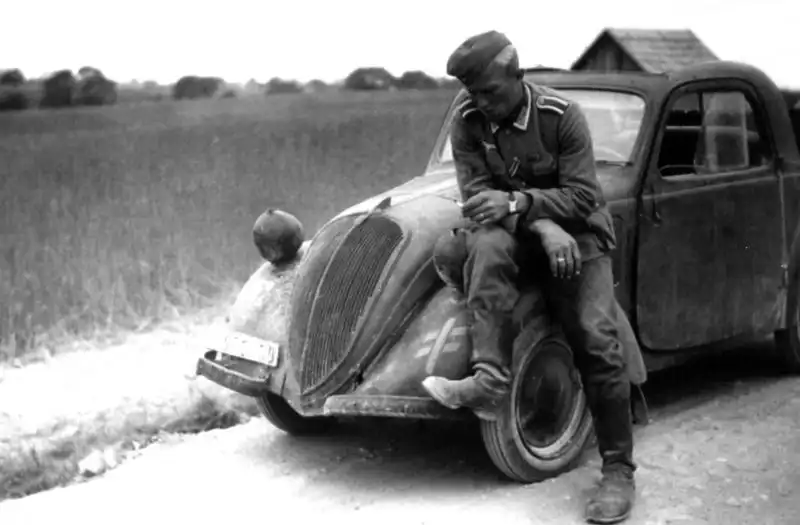
This wartime photograph shows a small Italian-built light car in Wehrmacht service during the summer of 1943. The vehicle is generally identified as a FIAT 500, or a closely related version such as the NSU-FIAT 500 or the French-built Simca 5. A German driver sits casually on the front fender, capturing a quiet moment of everyday military life away from combat.
From Civilian Car to Military Vehicle
The original FIAT 500, popularly known as the Topolino ("Little Mouse"), was introduced in 1936 as an economical civilian automobile. Compact, lightweight, and fuel-efficient, it became one of Europe's most recognizable small cars before the war.
Although never designed as a military vehicle, its simplicity and reliability made it useful for secondary duties. As German forces expanded across Europe, thousands of civilian automobiles of many different makes were requisitioned or incorporated into military service.
Foreign Vehicles in Wehrmacht Service
Contrary to popular belief, the Wehrmacht did not rely exclusively on German-built vehicles. Its transport fleet included large numbers of captured or imported automobiles manufactured in Italy, France, Czechoslovakia, Belgium, and other occupied or allied countries.
Maintaining such a diverse collection of vehicles presented constant logistical challenges, as mechanics had to work with different engines, spare parts, and maintenance procedures.
The 3rd Panzergrenadier Division
The divisional insignia visible on the hood identifies the vehicle as belonging to the 3rd Panzergrenadier Division. By 1943, this formation was heavily engaged on the Eastern Front, where mobility remained essential despite deteriorating road conditions and increasing Soviet resistance.
Small cars such as this were commonly employed for:
- transporting officers;
- courier and liaison duties;
- delivering documents and small supplies;
- short-distance staff transportation.
What the Photograph Shows
- A German driver resting beside his vehicle.
- A FIAT 500-type light car in Wehrmacht service.
- The insignia of the 3rd Panzergrenadier Division.
- An example of civilian automobiles adapted for military use.
Rather than illustrating combat, the photograph documents the routine transport activities that kept military formations functioning behind the front lines.
Historical Significance
While tanks and armored vehicles often dominate discussions of World War II, light passenger cars performed countless everyday tasks that rarely attracted attention. They carried officers, messengers, mechanics, medical personnel, and supplies, helping maintain communication and mobility across vast operational areas.
This photograph also illustrates the multinational nature of the Wehrmacht's vehicle fleet, which relied extensively on both captured and allied civilian automobiles throughout the war.
Photo Information
- Vehicle: FIAT 500-type light car.
- Unit: 3rd Panzergrenadier Division.
- Location: USSR.
- Date: Summer 1943.
- Photographer: Unknown.
Recommended Literature
- John Milsom — German Military Transport of World War II.
- Bryan Perrett — German Military Vehicles.
- Reinhard Frank — The Wehrmacht at War 1939–1945.
- Philip Trewhitt — Armored Fighting Vehicles of World War II.
This image offers a reminder that military mobility depended not only on tanks and trucks but also on countless small passenger cars. Vehicles like the FIAT 500 quietly carried out essential transport duties, becoming an everyday part of Wehrmacht operations despite their civilian origins.