Dramatic winter 1942 photograph showing a Red Army soldier in winter gear inspecting a catastrophic explosion-damaged German Pz.Kpfw. IV medium tank during the Battle of Moscow.
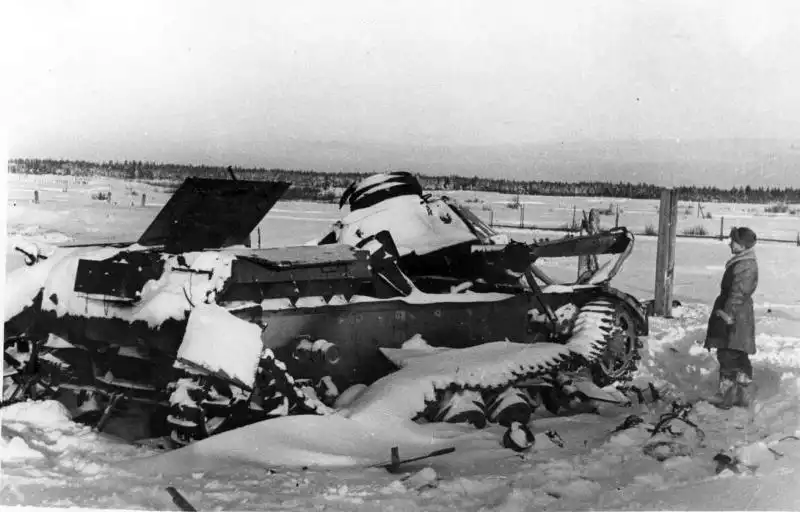
Soviet Soldier Inspecting a Destroyed German Pz.Kpfw. IV Near Moscow (Winter 1942)
This striking frontline photograph taken in the Moscow region during the winter of 1941–1942 shows a Red Army soldier, clad in a traditional sheepskin coat (polushubok) and felt boots (valenki), inspecting the blown-out wreckage of a German Pz.Kpfw. IV medium tank.
The scene depicts the heavy armored losses sustained by Nazi Germany's Wehrmacht during the Soviet winter counteroffensive, which pushed Army Group Centre back from the gates of Moscow and shattered the myth of German invincibility.
Technical Assessment of the Destroyed Armor
The wreckage illustrates the severe catastrophic destruction caused by internal ammunition detonation or explosive demolition:
- Variant Identification (Pz.Kpfw. IV Ausf. E/F1): The short stubby barrel of the 7.5 cm KwK 37 L/24 tank gun indicates an early short-barreled variant of the Panzer IV (Ausf. E or F1), designed primarily for infantry support and close-range bombardment prior to the introduction of long-barreled high-velocity guns.
- Catastrophic Internal Detonation: The hull plates have been ruptured and the heavy gun turret has collapsed into the fighting compartment, a classic result of an internal ammunition rack explosion following a penetrative hit or deliberate demolition by the retreating crew.
- Winter Conditions and Equipment: Deep snow covers the overturned tracks and roadwheels, underscoring the extreme sub-zero weather conditions that severely impacted German mechanical reliability during the winter of 1941–1942.
- Red Army Winter Gear: The Soviet soldier's functional winter uniform—featuring sheepskin insulation and thick felt valenki—reflects the Red Army's superior adaptation to Arctic-like operational environments compared to Wehrmacht troops suffering from severe winter clothing shortages.
The Strategic Turning Point at Moscow
The failure of Operation Typhoon and the subsequent Soviet counter-offensive marked the end of Blitzkrieg warfare on the Eastern Front. Hundreds of German tanks and armored vehicles were abandoned or destroyed along the approaches to Moscow, forcing the German army onto the defensive across the central front.
📍 Location: Moscow Region, RSFSR, USSR
📅 Date: Winter 1942
📷 Photographer: Unknown
📰 Primary Source: Russian State Film and Photo Archive (RGAKFD) / Central Archive of the Russian Ministry of Defence (CAMD)
Recommended reading:
- Battlefield analysis: German tank losses during the Soviet Moscow counteroffensive (1941–1942)
- Armor evolution: The short-barreled 7.5 cm KwK 37 gun on early Panzer IV models
- Winter warfare: Logistics, clothing, and mobility challenges on the Eastern Front in winter 1941
- Operational history: The defense of Moscow and the counteroffensive of the Kalinin and Western Fronts