The wreckage of the Soviet armored train “For the Motherland!” after devastating Luftwaffe air attacks near Voroshilovgrad in July 1942.
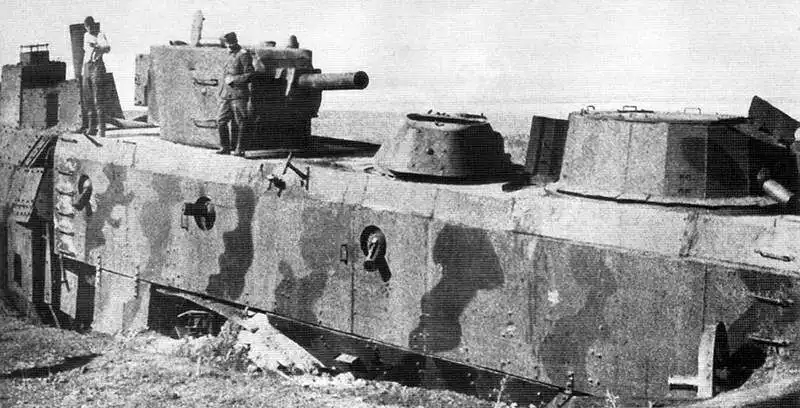
This dramatic photograph shows the shattered remains of the Soviet armored train “For the Motherland!” after repeated attacks by German aircraft near Voroshilovgrad (modern-day Luhansk) in July 1942.
The image captures one of the many fierce battles fought during the German summer offensive of 1942, when Soviet forces attempted to slow the rapid advance of the Wehrmacht toward the Don River, the Caucasus, and Stalingrad.
The armored train's twisted and damaged fighting platforms stand as a reminder of both the strength and vulnerability of this unique weapon of war.
Armored Trains on the Eastern Front:
Armored trains played a significant role during the early years of the German-Soviet War. Equipped with artillery, machine guns, anti-aircraft weapons, and heavy armor, they served as mobile fortresses capable of supporting infantry, defending railway lines, and delivering powerful fire support.
The vast railway network of the Soviet Union made armored trains particularly valuable. They could quickly redeploy to threatened sectors and bring substantial firepower to areas where conventional artillery was unavailable.
However, their effectiveness depended entirely on control of the railway system. Once tracks were damaged or enemy aircraft appeared overhead, their freedom of movement could vanish almost instantly.
An Unusual Fighting Platform:
One of the most remarkable features visible in the photograph is the train's heavily armed forward armored platform.
According to surviving descriptions, the platform carried an extraordinary combination of weapons:
- A turret from a KV-2 heavy tank
- A modified T-34 turret armed with a 45 mm gun
- A turret mounting a 76 mm Model 1902 field gun
This mixture reflects the improvisational nature of wartime Soviet armored train construction. Designers often combined whatever armored components and weapons were available, creating formidable but highly unconventional fighting vehicles.
The result was a train capable of engaging infantry, artillery positions, armored vehicles, and even low-flying aircraft.
The Battle for Rodakovo:
On 13 July 1942, the armored train “For the Motherland!” and another Soviet armored train fought German forces near Rodakovo Station.
As German pressure increased, the train became a prime target for Luftwaffe aircraft. On 15 July, while operating on the Rodakovo–Melovaya railway line, it endured three separate air attacks.
The third strike proved decisive.
Approximately thirty German bombers participated in the raid. Heavy bombs struck the train, destroying the anti-aircraft platform, wrecking the heavy-gun carriage, and severely damaging the armored locomotive's tender. Several fighting cars were thrown from the tracks.
The attack demonstrated how dangerous concentrated air power had become by the summer of 1942.
When Air Power Defeated Armor:
The destruction of the train highlights an important reality of modern warfare. Armored trains could withstand artillery fire and small-arms attacks, but they remained highly vulnerable to repeated aerial bombardment.
Unlike tanks, they could not maneuver away from danger. Their movement was restricted to the rails beneath them.
Once German aircraft established control of the skies over a section of track, even a heavily armed armored train could become trapped and systematically destroyed.
The fate of “For the Motherland!” illustrates the growing dominance of air power on the Eastern Front during 1942.
The Final Withdrawal:
After the devastating attacks, the surviving members of the crew faced a difficult decision. During the night of 15–16 July, they removed as much usable weaponry and equipment as possible before abandoning the wrecked train.
The remaining personnel withdrew toward Melovaya Station, leaving behind what had once been one of the Southern Front's mobile strongpoints.
Two days later, on 17 July 1942, German troops photographed the wreckage that appears in this image.
Today, the photograph survives as a rare record of a Soviet armored train destroyed during one of the most difficult periods of the war.
📍 Location: Voroshilovgrad (Luhansk), Ukrainian SSR, USSR
📅 Date: 17 July 1942
📷 Photographer: Unknown
Recommended Reading:
- Wilfried Kopenhagen — Armored Trains of World War II
- Mikhail Kolomiets — Armored Trains of the Red Army 1930–1945
- David Glantz — To the Gates of Stalingrad
- Robert Forczyk — Case Red: The Collapse of France (for comparative armored train operations and air power)
- Chris Bellamy — Absolute War: Soviet Russia in the Second World War
- Steven J. Zaloga — Armored Thunderbolt: The U.S. Army Sherman in World War II (for broader context on armored warfare and air attack doctrine)