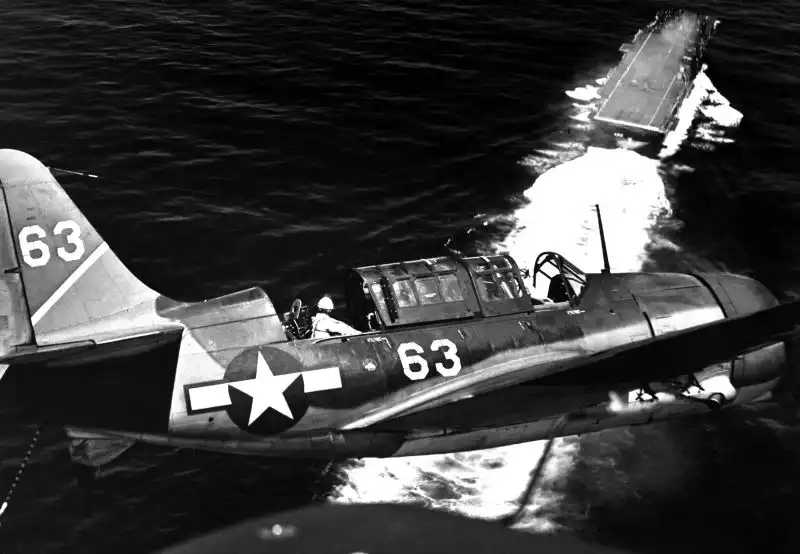
SB2C Helldiver bombers landing on USS Yorktown in the Pacific, 1944. A dramatic WWII carrier aviation moment captured in action.
A Split-Second of Precision:
This spectacular photograph captures two American SB2C Helldiver dive bombers approaching the aircraft carrier USS Yorktown (CV-10) for landing in July 1944.
Everything in this moment is about timing:
- Speed
- Alignment
- Precision
One mistake — and the result could be fatal.
The Aircraft – Curtiss SB2C Helldiver:
The planes in the image are Curtiss SB2C Helldiver dive bombers.
Nicknamed “Helldiver,” the aircraft was designed for:
- Carrier-based operations
- Dive bombing enemy ships and positions
- Delivering heavy ordnance with precision
Despite early reliability issues, it became a key strike aircraft in the later years of the war.
The Carrier – USS Yorktown (CV-10):
The landing is taking place on USS Yorktown (CV-10), an Essex-class aircraft carrier.
This ship played a major role in:
- Pacific naval campaigns
- Carrier-based strike operations
- Supporting amphibious assaults
It represented the growing power of U.S. naval aviation.
The Danger of Carrier Landings:
Landing on an aircraft carrier during WWII was one of the most dangerous tasks a pilot could face.
Pilots had to:
- Align perfectly with the flight deck
- Catch an arresting wire with a tailhook
- Land within a very short distance
At the same time:
- The deck was constantly moving
- Wind conditions changed rapidly
- Other aircraft were often nearby
👉 And here we see two aircraft landing almost simultaneously — that’s next-level skill.
Pacific Theater Context:
By July 1944, the United States had gained significant momentum in the Pacific War.
Carrier aviation was crucial for:
- Attacking Japanese bases
- Supporting island invasions
- Maintaining air superiority over vast ocean distances
Aircraft carriers like the Yorktown were essentially floating airbases.
Coordination and Discipline:
This image highlights the level of coordination required:
- Pilots
- Deck crews
- Signal officers
All working together in real time.
There was no room for hesitation.
The Human Factor:
Behind each aircraft:
- A pilot and rear gunner
- Hours of combat missions
- Fatigue and stress
And still — they had to land perfectly.
A Moment of Controlled Chaos:
At first glance, the image looks calm.
But in reality, it represents:
- High tension
- Extreme focus
- Controlled chaos
This is carrier aviation at its peak.
Historical Photograph Information:
Location: Pacific Ocean
Date: July 1944
Photographer: Unknown
Source:
U.S. Defense Imagery Archive
Recommended Books on Carrier Aviation:
1. The Fast Carriers — Clark G. Reynolds
2. Carrier Pilot — Norman Hanson
3. Pacific Crucible — Ian W. Toll
4. Hellcat vs Zero — Edward M. Young