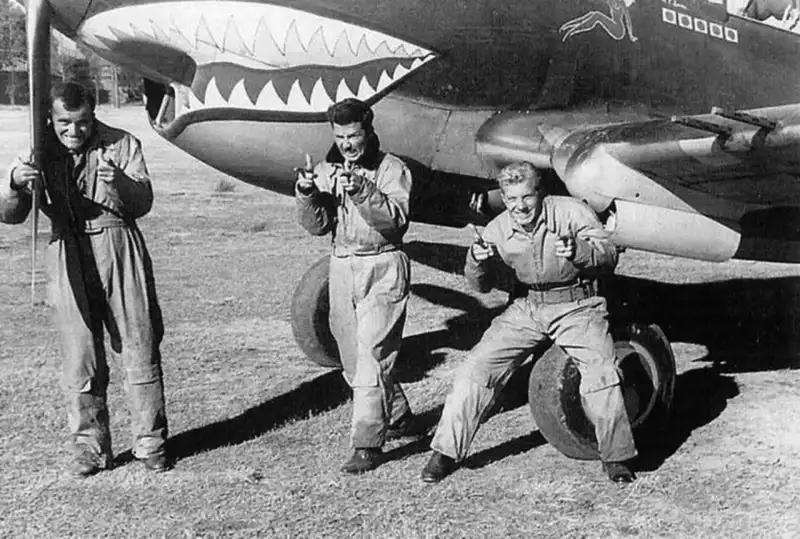
Flying Tigers pilots pose with a Curtiss P-40 fighter in China, 1942. A legendary WWII image of American volunteer aviators in combat.
Legends in Formation:
This photograph shows American pilots of the “Flying Tigers” posing with a Curtiss P-40 fighter in China in 1942.
Confident stance.
Relaxed posture.
But behind this image lies one of the most famous air combat units of World War II.
The Unit – Flying Tigers:
The pilots belonged to the Flying Tigers, officially known as the American Volunteer Group (AVG).
This unit consisted of:
- American pilots and ground crew
- Volunteers recruited before the U.S. formally entered the war
They operated in China between:
👉 August 1941 and July 1942
Fighting against Japanese forces.
Not Just Volunteers:
Although often called volunteers, many members of the Flying Tigers were:
- Former U.S. military personnel
- Recruited under contracts
- Paid for their service
This made them, in practical terms, closer to contract fighters than traditional military volunteers.
The Aircraft – Curtiss P-40 Warhawk:
The aircraft in the image is a Curtiss P-40 Warhawk, one of the most recognizable fighters of the early war period.
The P-40 was known for:
- Rugged construction
- Good diving performance
- Reliability in harsh conditions
While not the most advanced fighter, it proved highly effective in capable hands.
The Iconic Shark Mouth:
One of the defining features of Flying Tigers aircraft was the famous:
👉 Shark mouth nose art
This design became one of the most iconic visual symbols of World War II aviation.
It gave the aircraft:
- A psychological edge
- Immediate recognizability
Designed with Help from The Walt Disney Company:
The unit’s emblem — the winged tiger — was created with the help of The Walt Disney Company.
This added to their strong visual identity and helped build their legendary status.
The “Hell’s Angels” Squadron:
The aircraft in the photograph carries the insignia of the 3rd Squadron, known as the “Hell’s Angels.”
The Flying Tigers were organized into three squadrons:
- Adam & Eves
- Panda Bears
- Hell’s Angels
Each had its own markings and identity.
Combat in China:
Operating in China, the Flying Tigers faced:
- Japanese air superiority
- Limited resources
- Harsh operating conditions
Despite this, they achieved notable success by:
- Using tactical advantages
- Avoiding dogfights when possible
- Exploiting the strengths of the P-40
From Legend to Official Unit:
In July 1942, the Flying Tigers were reorganized into the 23rd Fighter Group of the U.S. Army Air Forces.
This marked their transition from a semi-independent unit
to an official part of the U.S. military structure.
Image and Reality:
This photograph captures:
- Confidence
- Style
- Identity
But behind it was:
- Risk
- Combat
- Constant danger
The contrast is part of what makes the image powerful.
Historical Photograph Information:
Location: China
Date: 1942
Photographer: Unknown
Recommended Books on the Flying Tigers:
1. Flying Tigers — Daniel Ford
2. God Is My Co-Pilot — Robert L. Scott
3. The Flying Tigers: The Untold Story — John Toland
4. AVG: The Flying Tigers — Sam Kleiner