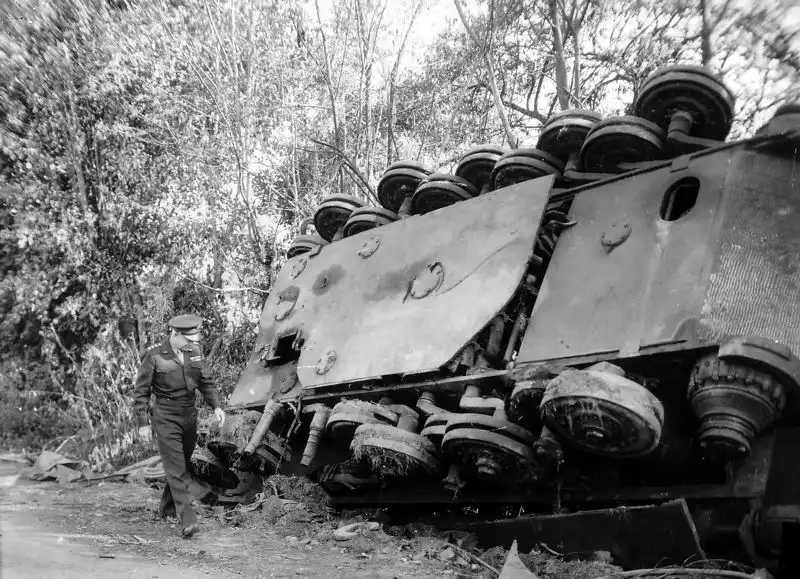
General Eisenhower poses near a destroyed Tiger II tank after the Falaise Pocket, 1944. A powerful WWII image of victory over German heavy armor.
Victory Captured in a Single Frame:
This photograph shows General Dwight D. Eisenhower standing near a destroyed German Tiger II tank on August 23, 1944, in the Chambois area of France.
The scene is striking:
👉 One of the most powerful Allied commanders
👉 One of the most powerful German tanks
One standing.
The other — overturned and abandoned.
The Man – Dwight D. Eisenhower:
The figure in the image is Dwight D. Eisenhower, Supreme Commander of Allied forces in Europe.
He was responsible for:
- Planning and executing the Normandy invasion
- Coordinating multinational Allied forces
- Overseeing operations that led to the collapse of German forces in France
His presence at the site reflects the importance of the moment.
The Tank – Tiger II:
Behind him lies a destroyed Tiger II, also known as the "King Tiger."
This tank was:
- One of the heaviest armored vehicles of the war
- Equipped with a powerful 88 mm gun
- Designed to dominate enemy armor
Yet here, it is:
- Disabled
- Abandoned
- Physically overturned
A fallen giant.
Identifying the Tiger II:
The vehicle can be identified as a Tiger II by:
- Its large, overlapping road wheels (nine per side)
- The position of the idler wheel relative to the last road wheel
- Its overall hull structure
These features distinguish it from similar German vehicles such as the Jagdtiger.
The Falaise Pocket:
The photograph was taken in the aftermath of the Falaise Pocket, where Allied forces trapped and destroyed large portions of the German army.
In this area:
- German units were encircled
- Equipment was abandoned or destroyed
- Retreat turned into collapse
The Tiger II was one of many casualties.
Not Destroyed in Battle Alone:
According to available information, the tank was:
- Disabled and abandoned on the road
- Later pushed aside by American forces using a bulldozer
- Overturned during the clearing process
This detail is important:
👉 Even the most powerful machines could end not in combat glory —
but as obstacles to be removed.
The Myth and Reality of Heavy Armor:
The Tiger II represented German engineering ambition.
But in reality, such tanks often faced:
- Mechanical issues
- Fuel shortages
- Limited mobility
In fast-moving campaigns like Normandy, these factors could be just as deadly as enemy fire.
A Symbol of Collapse:
The image carries strong symbolic meaning:
- The commander of victorious forces
- Standing beside a defeated war machine
It visually represents the shift in power on the Western Front in 1944.
War Reduced to Objects:
What once required:
- Factories
- Engineers
- Crews
- Logistics
Now lies discarded.
A massive investment reduced to scrap.
Historical Photograph Information:
Location: Chambois, France
Date: August 23, 1944
Photographer: Unknown
Recommended Books on Normandy and German Armor:
1. Panther vs Sherman — Steven Zaloga
2. The Battle for Normandy — Antony Beevor
3. Tiger II: King Tiger — Thomas L. Jentz
4. Armored Thunderbolt — Steven Zaloga