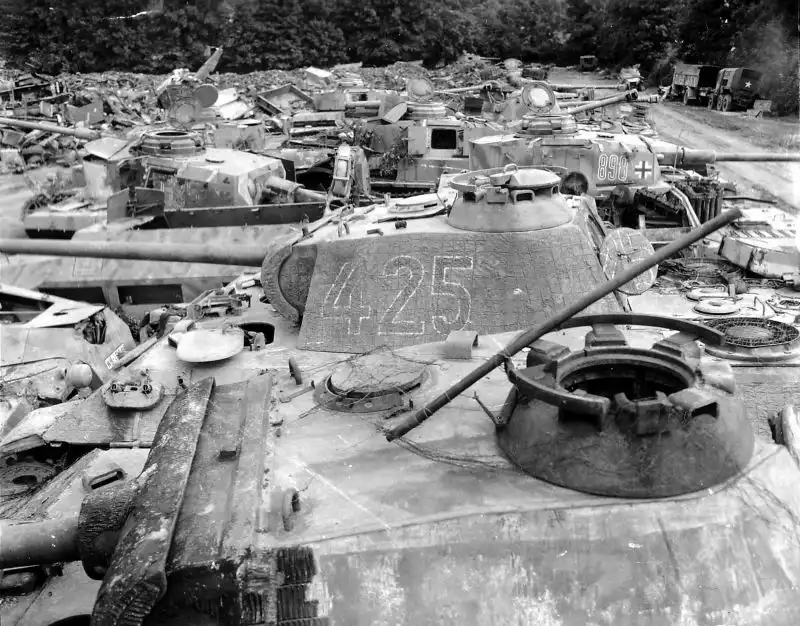
Captured German tanks and vehicles gathered after the Falaise Pocket, 1944. A powerful WWII image of defeat and destruction in Normandy.
A Graveyard of Steel:
This photograph shows a collection point of damaged and captured German armored vehicles in France, 1944, following the destruction of German forces in the Falaise Pocket.
What we see is not a battlefield —
👉 It is what remains after the battle is already decided.
Rows of abandoned, damaged, and captured machines form a silent testament to collapse.
The Vehicles – Panther Tank and Panzer IV:
Among the vehicles visible in the image are:
- Panther tank (Panzerkampfwagen V)
- Panzer IV, including late-war variants
- German armored personnel carriers
These vehicles once formed the backbone of German armored forces in Normandy.
The Falaise Pocket:
The image is directly connected to the Falaise Pocket, one of the decisive events of the Normandy campaign.
In August 1944:
- Allied forces encircled large parts of the German army
- Retreat routes were cut off
- Thousands of vehicles were destroyed or abandoned
The pocket became a killing ground for German forces attempting to escape.
Units Destroyed:
Many of the vehicles in such collection points belonged to elite formations, including:
- SS Panzer divisions such as "Das Reich"
- Wehrmacht armored units
These formations had previously been among the most powerful in the German military.
By this point, they were shattered.
Why Vehicles Were Abandoned:
Not all vehicles were destroyed in direct combat.
Common reasons for abandonment included:
- Lack of fuel
- Mechanical breakdown
- Damage without immediate repair capability
- Encirclement and forced retreat
In fast-moving operations, even intact vehicles could be left behind.
Collection Points:
After battles, Allied forces often created collection points for captured and destroyed equipment.
These served several purposes:
- Clearing roads and operational areas
- Inspecting enemy technology
- Salvaging usable parts
- Documenting enemy losses
This photograph captures one such site.
The Scale of Defeat:
The number and condition of vehicles in the image highlight the scale of German losses.
It is not about a single destroyed tank —
👉 It is about an entire armored force broken apart.
The Falaise Pocket marked a turning point where German forces in Normandy ceased to function as an organized force.
War as Attrition:
This image reflects the industrial nature of World War II:
- Machines produced in factories
- Deployed in mass
- Destroyed or abandoned in large numbers
Victory was not only about tactics —
but about sustaining and replacing losses.
Silence After the Battle:
There are no soldiers in the image.
No movement.
Only damaged machines left behind.
The silence is striking —
because we know what must have happened before.
Historical Photograph Information:
Location: France
Date: 1944
Photographer: Unknown
Recommended Books on the Normandy Campaign:
1. The Battle for Normandy — Antony Beevor
2. Overlord — Max Hastings
3. Closing the Falaise Gap — Brian Reid
4. Panzer Operations — Erhard Raus