Red Army troops under the command of Senior Lieutenant A. Burak attack Wehrmacht positions with 45 mm artillery support and smoke cover in July 1943.
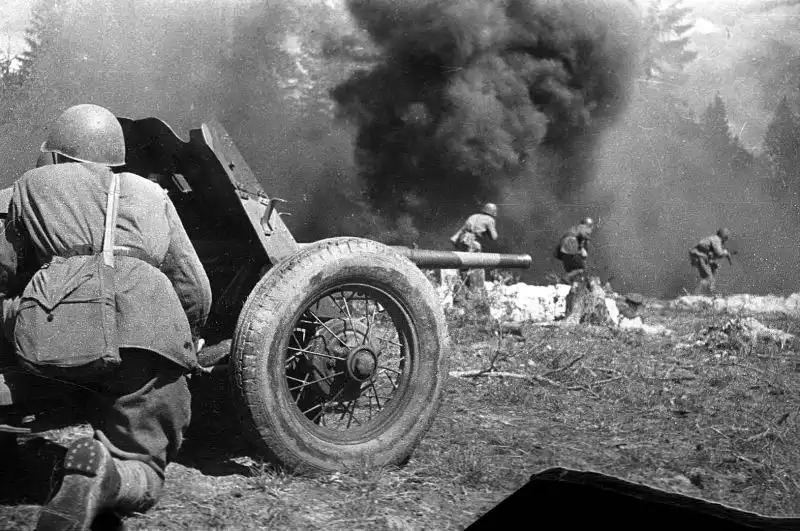
Red Army Assault Under Artillery and Smoke (July 1943)
This wartime photograph shows Red Army soldiers from a unit commanded by Senior Lieutenant A. Burak advancing against Wehrmacht defensive positions. The attack is supported by 45 mm artillery and carried out under a smoke screen, a classic combined-arms tactic used to reduce enemy observation and defensive fire.
The image was taken in July 1943, during one of the most intense phases of fighting on the Eastern Front.
Photo Information:
- Location: USSR
- Date: July 1943
- Photographer: Mikhail Savin
What the Photo Shows:
The photograph captures an infantry assault in progress. Soldiers move forward while artillery provides direct support and smoke obscures the battlefield in order to:
- Limit enemy visibility
- Disrupt aimed fire from machine guns and anti-tank weapons
- Allow attacking troops to close the distance to enemy positions
This is not a staged scene but a moment of real combat movement, where coordination between infantry and artillery was essential for survival and success.
The Role of 45 mm Artillery:
The 45 mm guns were among the most common light anti-tank and support weapons of the Red Army. During assaults like this, they were used to:
- Suppress enemy machine-gun nests
- Destroy light field fortifications
- Engage enemy strongpoints at close and medium range
- Provide immediate fire support to advancing infantry
Their relatively small size allowed them to be brought forward quickly, keeping pace with attacking troops.
Smoke Screens in Soviet Tactics:
Smoke played a critical role in offensive operations. A well-prepared smoke screen could:
- Blind enemy observers and gunners
- Hide the direction and timing of the main attack
- Reduce casualties during the most dangerous phase of the advance
- Create confusion in enemy ranks
By 1943, the Red Army increasingly relied on coordinated artillery, smoke, and infantry movement as part of more mature offensive tactics.
July 1943: A Critical Month:
July 1943 was a decisive period on the Eastern Front, marked by massive battles and continuous offensive and defensive operations. Infantry units were often required to:
- Attack well-prepared defensive lines
- Advance under heavy fire
- Rely closely on artillery and supporting weapons
- Exploit breakthroughs created by armor and guns
Scenes like the one shown in this photograph were repeated countless times across the front, becoming part of the reality of modern industrial warfare.
Leadership at the Small-Unit Level:
The mention of Senior Lieutenant A. Burak highlights the importance of junior and mid-level commanders in combat. These officers were responsible for:
- Leading troops under fire
- Coordinating with artillery support
- Maintaining momentum during assaults
- Making rapid decisions in chaotic battlefield conditions
Success or failure at this level often determined whether an attack stalled or succeeded in breaking through enemy defenses.
Why This Photograph Matters:
This image is significant because it shows:
- A combined-arms assault in action
- The practical use of smoke and artillery support
- The human side of offensive operations
- The tactical evolution of the Red Army by 1943
It illustrates how victories were achieved not only through tanks and massive bombardments, but also by infantry advancing step by step under fire.
Conclusion:
The photograph of Red Army troops advancing under artillery support and smoke in July 1943 captures a moment of determination and coordinated effort. Led by Senior Lieutenant A. Burak, these soldiers moved forward against prepared defenses, relying on teamwork, supporting fire, and tactical planning — an example of how the Red Army conducted offensive operations during the decisive battles of 1943.