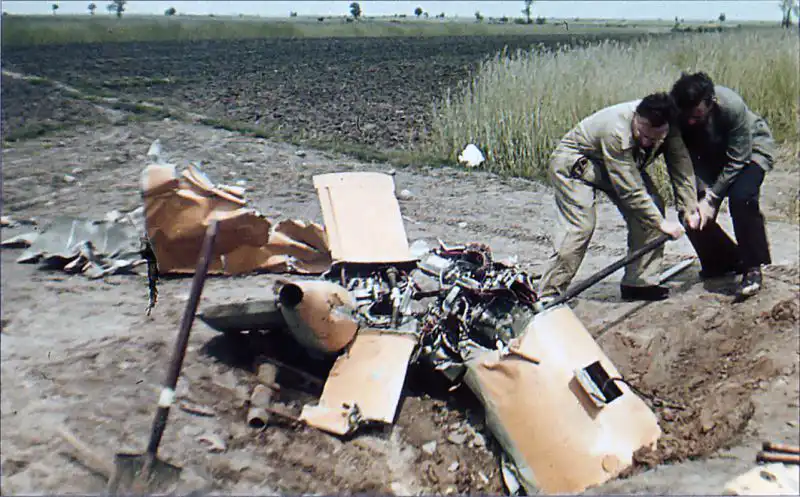
German engineers using a crowbar to pry the rocket engine section of a crashed Blohm & Voss Bv 143 missile out of a crater in Peenemünde, August 1941.
Recovering the Propulsion Unit of an Experimental Bv 143 Missile:
This striking historical photograph from August 27, 1941, captures two German aerospace technicians working at an impact site near the Peenemünde-West testing facility. Using a heavy iron pry bar, the engineers are seen attempting to unearth the embedded propulsion unit and tail assembly of a prototype Blohm & Voss Bv 143 (BV-143) anti-ship guided missile that crashed during powered flight trials.
While the previous image showed field personnel collecting scattered airframe debris, this close-up photograph highlights the grueling physical labor involved in military crash investigation, focusing on the recovery of the missile's core propulsion and guidance machinery.
Investigating Test Failures at Peenemünde:
During the early 1940s, the Luftwaffe's experimental weapons testing station at Peenemünde conducted hundreds of test drops to evaluate stand-off anti-ship technology. Because telemetry and remote data logging were in their infancy, physical recovery of every crashed prototype was vital for engineering teams.
By exhuming the buried engine casing, control actuators, and internal gyroscopes from the crash crater, technicians from Blohm & Voss and the Reich Air Ministry could examine mechanical components for structural fractures, ignition failures, or control surface jams that led to the flight failure.
The Bv 143 Rocket Propulsion and Control Tail:
The wreckage visible in the crater showcases the rear fuselage layout of the Bv 143 missile:
- Solid-Fuel Rocket Booster: The missile utilized a short-burn solid-propellant rocket motor designed to accelerate the weapon to attack speed once its mechanical sensor probe made contact with the ocean surface.
- Tail Control Surfaces: The cruciform tail fins and control surfaces, visible in the mud, were linked to pneumatic and gyroscopic autopilots intended to maintain level sea-skimming flight.
The failure rate during these August 1941 trials was exceptionally high, as the primitive mechanical sensors frequently triggered the rocket engine prematurely, causing the missile to pitch violently into the ground or ocean.
Agfacolor Film and Modern Colorization:
The image is presented in full color, capturing the muted tones of the Pomeranian landscape and the technicians' work wear. During World War II, Germany was a global leader in color photography thanks to Agfacolor Neu slide film introduced in the late 1930s, which was actively used by Luftwaffe propaganda units and military research centers like Peenemünde.
Whether sourced from an original Agfacolor transparency or painstakingly restored through modern digital colorization, the photograph provides a vivid, realistic window into the pioneer era of guided missile development.
📍 Location: Peenemünde, Pomerania, Germany
📅 Date: August 27, 1941
📷 Photographer: Unknown
Recommended reading:
- Crash investigation methods and telemetry at Peenemünde-West
- The rocket propulsion systems of early German guided missiles
- Development of Agfacolor Neu color photography in WWII Germany
- Why the Blohm & Voss Bv 143 program was ultimately cancelled