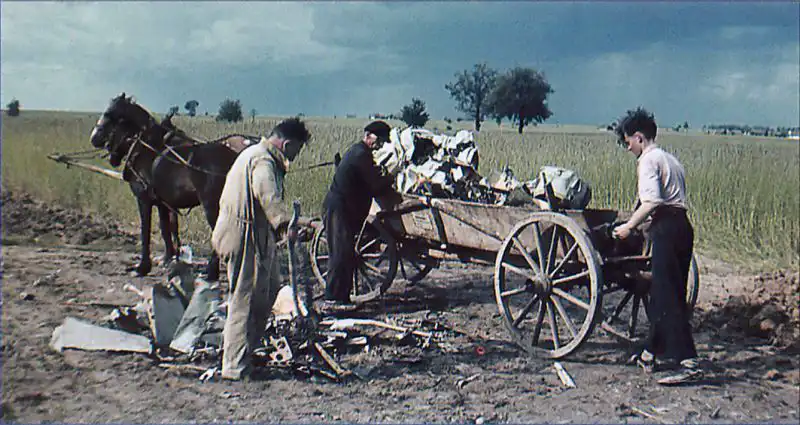
A striking visual contrast from 1941: workers load the shattered remains of a highly advanced Blohm & Voss Bv 143 guided missile onto a simple horse-drawn cart.
High-Tech Meets Horsepower: Recovering the Bv 143:
This remarkable color photograph, taken on August 27, 1941, captures one of the most surreal visual contrasts of the Second World War. Here, in a muddy agricultural field near the top-secret Peenemünde testing facility, workers are seen loading the crushed aluminum fuselage of a cutting-edge Blohm & Voss Bv 143 guided anti-ship missile onto a rustic, horse-drawn wooden wagon.
The image perfectly encapsulates the bizarre duality of the German war machine in 1941: developing futuristic aerospace technology and cruise missiles, while still heavily relying on draft animals for essential logistics and transport.
The Reality of Test Range Logistics:
While Peenemünde-West was the most technologically advanced aerospace research center on the planet, the surrounding landscape of Pomerania remained deeply rural. When experimental weapons like the Bv 143 crashed during flight trials, they often landed in soft, muddy farmers' fields where heavy military recovery trucks would easily bog down.
Because motorized transport and aviation fuel were strictly rationed and prioritized for frontline combat units, test range personnel frequently commandeered local agricultural resources. Draft horses and simple wooden carts provided a reliable, off-road solution for dragging heavy, shattered missile components out of the muck.
Scavenging Aluminum and Avionics:
In this phase of the recovery operation, the team is gathering the bulky structural remnants of the missile's airframe. Following a test failure, retrieving this debris was critical for two main reasons:
- Failure Analysis: Engineers needed to inspect the twisted control linkages, shattered wing spars, and delicate gyroscopic autopilot components to determine exactly why the mechanical sea-skimming sensor failed and caused the crash.
- Resource Recycling: Germany faced severe shortages of strategic materials. Every scrap of aviation-grade duralumin and steel from crashed prototypes was meticulously collected and melted down to be reused in the production of new weapons.
As the men heap the advanced aerodynamic casing onto a cart design that hasn't changed in centuries, the photograph stands as a fascinating testament to the practical, often unglamorous reality behind early rocket science.
📍 Location: Peenemünde, Pomerania, Germany
📅 Date: August 27, 1941
📷 Photographer: Unknown
Recommended reading:
- The heavy reliance on horse-drawn transport (Bespanngespanne) in the German war economy
- Logistics and prototype recovery operations at the Peenemünde-West test site
- Strategic material shortages and aluminum recycling in WWII Germany
- The contrast of high technology and rural infrastructure in the Third Reich