Historical archival photograph from 1942 depicting a massive six-engine Messerschmitt Me.323 "Gigant" transport plane resting in a Romanian pasture alongside a flock of grazing sheep.
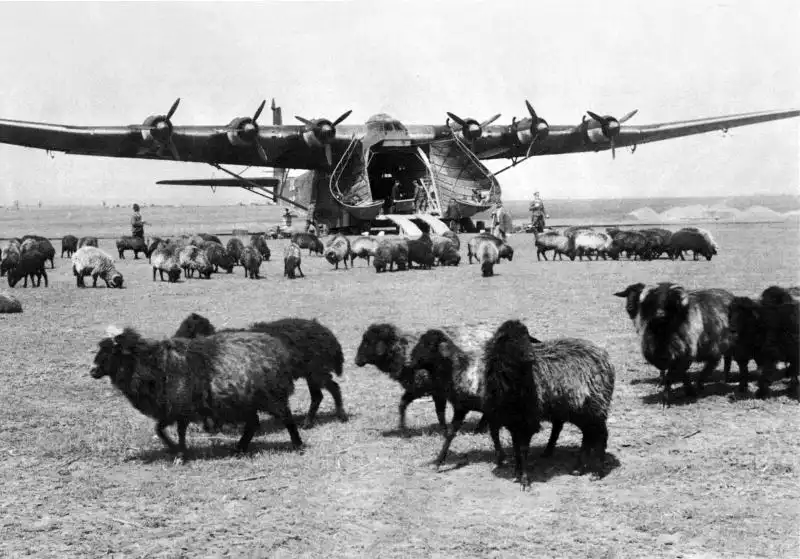
Messerschmitt Me.323 "Gigant" Heavy Transport Aircraft in Romania (1942)
This remarkable and surreal historical photograph from 1942 captures a massive six-engine Messerschmitt Me.323 “Gigant” heavy transport aircraft of the Luftwaffe resting on an unpaved field in Romania, with its large front cargo doors wide open while a flock of local sheep grazes peacefully in the foreground.
The contrast between cutting-edge heavy military logistics and traditional pastoral life illustrates the unique field conditions on the Southern sector of the Eastern Front.
Technical Innovations of the Me.323 "Gigant"
As the largest land-based transport aircraft deployed during World War II, the Me.323 provided unprecedented heavy airlift capabilities for German forces:
- Glider Origin: Conceived originally as the heavy unpowered Me.321 glider for Operation Sea Lion, the design was adapted into a powered airlifter by installing six French Gnome-Rhône 14N radial engines.
- Clamshell Front Doors: The iconic upward-and-outward opening nose doors enabled direct ramp loading of heavy machinery, field artillery, light armored vehicles, or up to 120 fully equipped soldiers.
- Multi-Wheel Landing Gear: To operate from unprepared field airstrips and agricultural pastures, the aircraft utilized an innovative ten-wheel tandem landing gear distribution system that spread weight evenly on soft soil.
- Payload Capacity: Capable of lifting up to 12 tons of freight, the "Gigant" served as a critical asset for rapid logistical repositioning.
Strategic Role in Romania (1942)
In 1942, Romania served as a vital operational staging hub for Axis forces advancing toward the Caucasus oil fields and the Crimean Peninsula. Specialized transport squadrons (such as KG z.b.V. 323) utilized Romanian airfields to ferry high-priority spare parts, ammunition, and medical evacuations between rear depots and frontline units.
📍 Location: Romania
📅 Date: 1942
📷 Photographer: Unknown (Luftwaffe Propaganda Company / PK)
📰 Primary Source: WWII Eastern European Aviation Archives
Recommended reading:
- The Messerschmitt Me.323 Gigant: Design history, production, and six-engine configuration
- Luftwaffe Heavy Transport Squadrons: Operations of KG z.b.V. 323 on the Eastern Front
- Axis Supply Lines in Southern Russia and the Caucasus (1942): The role of air transport
- Tactical Airfield Operations: How heavy transport planes operated from unpaved fields