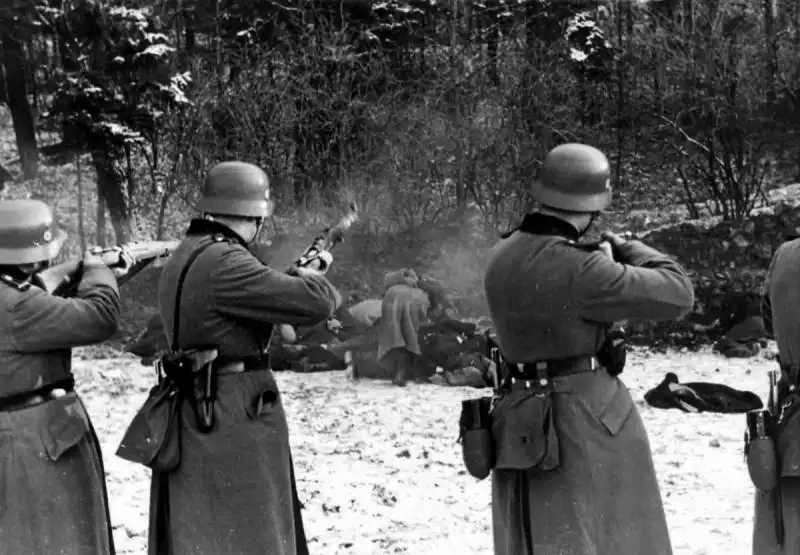
Photo documenting the mass execution of 56 Polish civilians by German occupation authorities in the Uzbornia Forest near Bochnia on 18 December 1939 during the early occupation of Poland.
Mass Execution of Polish Civilians near Bochnia (December 1939):
This wartime photograph documents the mass execution of 56 Polish civilians carried out by German occupation authorities during the occupation of Poland. The execution took place on 18 December 1939 in the Uzbornia Forest near the town of Bochnia. It was carried out in reprisal for an attack on a German police post by members of the Polish underground White Eagle organization.
The image reflects the brutal reality of the early occupation period, when collective punishment and terror were used to suppress resistance and intimidate the civilian population.
Photo Information:
- Location: Uzbornia Forest, near Bochnia, Poland
- Date: 18 December 1939
What the Photo Shows:
The photograph captures the moment of a reprisal execution carried out by German occupation authorities. It is not a battlefield scene, but an image of violence directed at civilians, illustrating how occupation policies quickly moved beyond military objectives to systematic repression.
Such actions were intended to:
- Punish communities for real or alleged resistance
- Spread fear and discourage further opposition
- Demonstrate the absolute power of the occupying authorities
- Break the social fabric of occupied regions
The forest setting reflects the secluded locations often chosen for reprisal executions, allowing such crimes to be carried out away from public view.
The Context of Reprisals in Occupied Poland:
Following the defeat of Poland in 1939, the German occupation authorities introduced a policy of collective punishment and reprisals against civilian communities. Even relatively small acts of resistance could result in:
- Arrests of hostages
- Summary executions
- Destruction of property
- Mass intimidation of local populations
The execution near Bochnia on 18 December 1939 formed part of this broader strategy of terror as a tool of control.
The White Eagle Underground Organization:
Polish resistance began forming almost immediately after the occupation. Organizations such as the White Eagle resistance organization carried out attacks against German police, administrative offices, and other occupation institutions.
While these operations demonstrated that Poland had not surrendered, the occupation authorities frequently responded with disproportionate collective reprisals, targeting civilians who often had no direct connection to the resistance.
Why Events Like This Were Documented:
Photographs of such crimes serve today as:
- Historical evidence of occupation policies
- Proof of systematic repression and terror
- Documentation for future investigations and remembrance
- A warning about how quickly war can turn into violence against civilians
They provide valuable historical evidence that the first months of the war already witnessed systematic violence against civilians as an integral part of German occupation policy.
Historical Significance of the Image:
This photograph is important because it shows:
- The nature of early German occupation in Poland
- The systematic use of collective punishment and terror against civilians
- The vulnerability of civilians under military rule
- A concrete example of how repression was implemented on the ground
It places faces and a location behind what might otherwise remain abstract statistics.
Conclusion:
The image of the mass execution near Bochnia on 18 December 1939 stands as a stark reminder of the brutality of occupation policies at the very beginning of World War II. It shows how violence against civilians became a deliberate instrument of control, leaving deep scars on communities and marking the start of years of suffering under occupation.
Remembering such events is essential—not only to honor the victims, but also to understand the human cost of war, occupation, and political repression.