A rare photograph shows a crashed Junkers Ju 87 Stuka after a forced landing on soft, waterlogged ground. The article explains why the aircraft overturned, how its fixed landing gear influenced the accident, and what this incident reveals about WWII combat aviation.
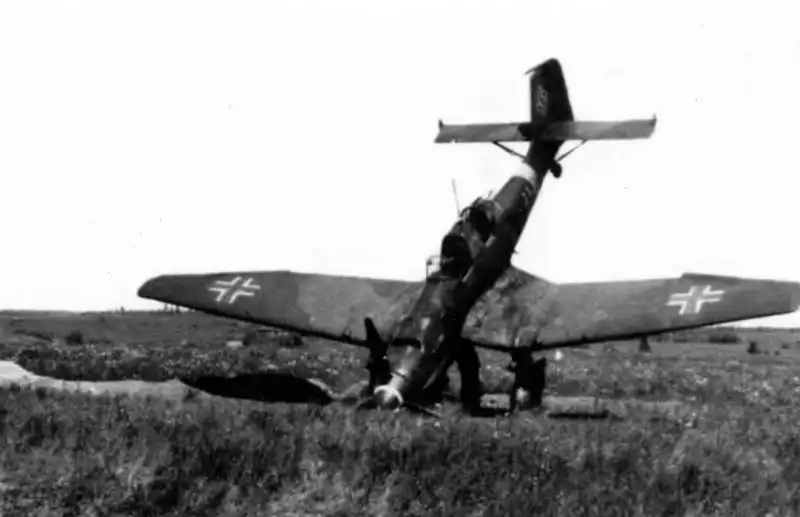
Crashed Junkers Ju 87 Stuka After a Forced Landing
The Junkers Ju 87 Stuka was one of the most recognizable aircraft of World War II. Although famous for its precision dive-bombing attacks, it was also vulnerable during emergency landings away from prepared airfields. This rare photograph captures a Ju 87 that has nosed over after attempting a forced landing on soft, waterlogged ground.
The overturned aircraft illustrates a classic nose-over accident, a hazard faced by many wartime aircraft operating from improvised landing sites.
Why the Ju 87 Overturned
The photograph does not appear to show a prepared runway. Instead, the aircraft seems to have landed on soft, waterlogged terrain, where the soil could not properly support the aircraft's weight.
The Ju 87 was equipped with fixed, non-retractable landing gear. While this design was rugged and reliable on firm surfaces, it could become hazardous on soft ground. As the wheels dug into the mud, rolling resistance increased dramatically. The aircraft's forward momentum, combined with its center of gravity, caused it to pivot over the landing gear, producing the characteristic nose-over position seen in the photograph.
Such accidents were not uncommon during wartime operations, particularly when aircraft were forced to land away from established airfields.
Landing Gear Design of the Junkers Ju 87
The Ju 87 featured one of the most distinctive landing gear designs of any aircraft of the Second World War. Its fixed undercarriage reduced mechanical complexity and increased structural strength, making the aircraft easier to maintain under field conditions.
Key Features
- Fixed, wide-track landing gear
- Strong construction suitable for rough but firm airstrips
- Large streamlined wheel fairings that reduced aerodynamic drag
- Excellent structural durability during normal operations
However, these same characteristics became a disadvantage on muddy or waterlogged ground. Once the wheels became embedded in soft soil, the aircraft could rapidly pitch forward despite the pilot's efforts to maintain control.
Forced Landings During the War
Throughout World War II, Luftwaffe aircraft frequently operated from temporary, damaged, or hastily prepared airfields. Combat damage and rapidly changing front lines often forced crews to land wherever suitable ground could be found.
Common reasons for forced landings included:
- Engine damage from anti-aircraft fire
- Fuel shortages
- Mechanical failures
- Deteriorating weather
- Navigational problems
Under such circumstances, preserving the crew was usually more important than saving the aircraft.
Why the Accident Was So Likely
Given the apparent ground conditions visible in the photograph, the risk of a nose-over accident was extremely high.
- Soft ground greatly increased rolling resistance
- The fixed landing gear acted as a pivot once the wheels dug in
- The aircraft's forward center of gravity encouraged pitching forward
- The absence of a prepared landing surface made the situation even more hazardous
Once the wheels became embedded, the aircraft's momentum would have carried it onto its nose or forward fuselage. Even when the crew escaped unharmed, damage from such accidents often made the aircraft uneconomical to repair in field conditions.
Unknown Location and Date
Unfortunately, no reliable information survives regarding the exact location or date of this photograph. This is common with wartime images that lack official documentation or identifiable landmarks.
Without unit markings, recognizable terrain, or archival records, assigning the photograph to a specific campaign would be speculative.
Operational Lessons
Although the Ju 87 proved highly effective as a dive bomber, this accident illustrates the compromises inherent in its design.
- Exceptional dive-bombing accuracy
- Simple and durable landing gear
- Reliable operation from rough but reasonably firm airfields
- Increased vulnerability during landings on soft or poorly prepared ground
As the war progressed and Luftwaffe units increasingly operated from improvised forward bases, such limitations became more significant.
Conclusion
This photograph of a crashed Junkers Ju 87 Stuka provides more than an image of a wrecked aircraft. It demonstrates how terrain, engineering design, and operational conditions could combine to produce an accident even when the aircraft survived combat. For historians and aviation enthusiasts alike, it offers valuable insight into the practical realities faced by WWII aircrews operating far from ideal airfields.
Recommended Literature
- Peter C. Smith — Junkers Ju 87 Stuka
- Manfred Griehl — Junkers Ju 87 Stuka
- William Green — Warplanes of the Third Reich
- Chris Goss — Luftwaffe Fighter-Bombers Over Britain