German troops assault Warsaw as Heinkel He 111 bombers fly overhead in September 1939, illustrating the destruction of the Polish capital during the opening campaign of World War II.
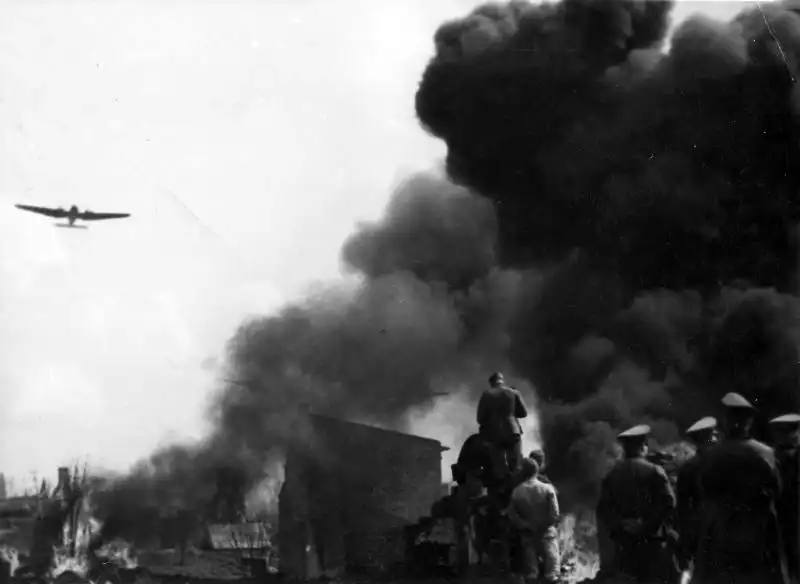
German Assault on Warsaw Under Heinkel He 111 Bombers (September 1939)
This dramatic wartime photograph captures German troops advancing toward Warsaw during the invasion of Poland in September 1939. Above them, the unmistakable silhouettes of Heinkel He 111 medium bombers can be seen flying over the city, while thick columns of smoke rise from fires caused by days of bombardment and fighting.
The image illustrates one of the earliest examples of modern combined-arms warfare, in which air power and ground forces operated together during the opening weeks of World War II.
Photo Information
- Location: Warsaw, Poland
- Date: September 1939
What the Photo Shows
The photograph depicts several key elements of the German assault:
- German infantry advancing toward the city
- Heinkel He 111 twin-engine bombers overhead
- Dense smoke rising from burning districts
- A capital already devastated by sustained combat
The scene demonstrates how aerial bombardment and ground operations were closely coordinated during the invasion of Poland.
The Heinkel He 111
The aircraft visible in the photograph are Heinkel He 111 medium bombers, one of the Luftwaffe's principal bomber types at the beginning of World War II. Originally developed during the 1930s, the He 111 became one of Germany's most widely used bombers during the early years of the conflict.
Its principal characteristics included:
- Twin-engine all-metal construction
- Crew of four to five men
- Internal bomb bay for medium bomb loads
- Long operational range for strategic and tactical missions
- Distinctive glazed nose that made the aircraft easily recognizable
During the invasion of Poland, He 111 units participated in attacks on transportation networks, military installations, supply routes, and urban areas supporting the Polish defense.
The Siege and Bombing of Warsaw
Warsaw endured continuous artillery fire and repeated air attacks throughout September 1939. German commanders sought to force the city's surrender by combining military pressure with sustained bombardment.
The fighting resulted in:
- Severe destruction across residential districts
- Large fires throughout the city
- Heavy civilian casualties
- Extensive damage to infrastructure and public services
The smoke visible in this photograph reflects the scale of the destruction inflicted during the siege.
The Final Assault on the Polish Capital
The battle for Warsaw marked the concluding phase of the Polish Campaign. Despite determined resistance by Polish military forces and civilians, the city eventually capitulated after weeks of fighting.
The capture of Warsaw led to:
- The collapse of organized Polish resistance in the capital
- The beginning of German occupation
- Years of repression and persecution under occupation rule
Combined-Arms Warfare at the Beginning of World War II
The photograph demonstrates how the German campaign relied on close cooperation between aviation, artillery, and advancing ground forces. Air superiority allowed bombers to strike targets behind the front while infantry continued its advance.
The invasion of Poland became one of the first major demonstrations of this style of warfare, influencing military operations throughout the early years of the conflict.
Historical Significance
This image is historically important because it documents:
- The opening campaign of World War II in Europe
- The visible presence of Heinkel He 111 bombers during operations over Warsaw
- The destruction of a European capital during modern combined-arms warfare
- The beginning of the German occupation of Poland
Rather than depicting only a battlefield, the photograph records the transformation of a major European city into a war zone during the first month of the global conflict.
Conclusion
The image of German troops advancing toward Warsaw beneath Heinkel He 111 bombers captures one of the defining moments of September 1939. It illustrates the combination of air power and ground assault that characterized the invasion of Poland and marked the beginning of World War II in Europe. The photograph remains a powerful visual record of the destruction suffered by Warsaw during the opening weeks of the conflict.
Recommended Literature
- Richard Overy — The Bombers and the Bombed
- Steven J. Zaloga — Poland 1939: The Birth of Blitzkrieg
- Alexander B. Rossino — Hitler Strikes Poland
- Roger Moorhouse — First to Fight: The Polish War 1939