Polish cavalry in Sochaczew during the Battle of the Bzura in September 1939, showing the largest Polish counteroffensive of the campaign and its outcome.
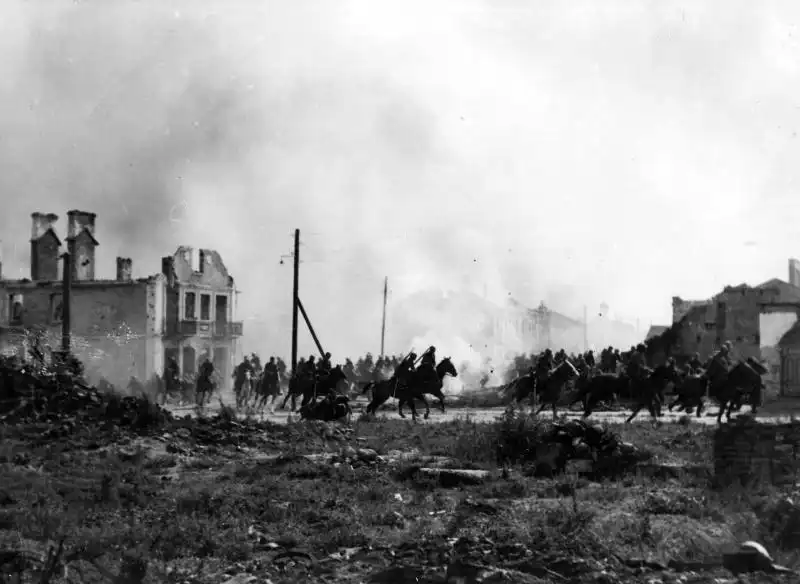
Polish Cavalry in Sochaczew (September 1939):
This wartime photograph shows Polish cavalry in the town of Sochaczew during the Battle of the Bzura in September 1939. The image belongs to one of the most dramatic episodes of the Polish Campaign, when Polish forces launched a powerful counteroffensive against advancing German troops.
For a short time, this counterattack forced several German formations onto the defensive and temporarily disrupted their operational timetable.
Photo Information:
- Location: Sochaczew, Poland
- Date: September 1939
What the Photo Shows:
The photograph captures Polish cavalry moving through the streets of Sochaczew during the battle. By 1939, cavalry was no longer a decisive arm on its own, but it still played an important role as:
- Mobile infantry
- Reconnaissance and screening forces
- Rapid reaction units
- Troops capable of quick movement and flexible deployment
In towns like Sochaczew, cavalrymen often fought dismounted, using their mobility to reach threatened sectors and reinforce defensive or attacking positions.
The Battle of the Bzura:
The Battle of the Bzura (9–19 September 1939) was the largest Polish counteroffensive of the campaign. Polish armies struck the flank of German forces advancing toward Warsaw.
During the first phase of the battle:
- Polish troops achieved tactical surprise
- Several German units were pushed back
- The German command had to divert additional forces to contain the offensive
However, the situation changed once German reinforcements arrived and the Luftwaffe established overwhelming air superiority.
Why the Counteroffensive Failed:
Despite early success, the Polish forces faced overwhelming difficulties:
- The Luftwaffe gained air superiority and repeatedly attacked Polish troop concentrations and supply routes
- Armored and motorized reinforcements strengthened the German defense
- Supply and communication problems weakened Polish coordination
- The Polish forces increasingly faced the danger of encirclement
Eventually, the German forces regained the initiative, and much of the Polish striking force was encircled and destroyed during the battle.
Polish Cavalry in 1939:
Contrary to popular myths, Polish cavalry did not charge tanks with sabers. In 1939, cavalry units were:
- Trained primarily as mobile infantry
- Equipped with rifles, machine guns, anti-tank rifles, and light artillery support
- Used for rapid maneuvers, flanking actions, reconnaissance, and delaying operations
In the Battle of the Bzura, cavalry formations fought alongside infantry to exploit breakthroughs and cover withdrawals, demonstrating both their flexibility and their vulnerability in modern warfare.
The Strategic Meaning of the Battle:
Although the Battle of the Bzura ended in defeat for Poland, it had important consequences:
- It delayed German operations in central Poland and temporarily eased pressure on Warsaw
- It demonstrated that the Polish Army remained capable of organized and determined resistance
- It forced the German command to divert forces from other axes of advance
The battle became a symbol of courage and initiative under hopeless strategic conditions.
Historical Significance of the Image:
This photograph is important because it shows:
- Polish cavalry in active operations during the 1939 campaign
- Fighting around the streets and approaches to Sochaczew during the Battle of the Bzura
- A moment from the largest Polish counteroffensive of the war's opening phase
- The human and operational dimension of a rapidly changing front
It reminds us that the September Campaign was not a simple collapse, but a series of hard-fought battles and counterattacks.
Conclusion:
The image of Polish cavalry in Sochaczew in September 1939 captures one of the defining moments of the Battle of the Bzura, when Polish forces briefly seized the initiative against a stronger enemy.
Although the counteroffensive ultimately failed, it demonstrated that the Polish Army remained capable of determined, coordinated operations even in the face of overwhelming German superiority. The battle remains one of the clearest examples of Polish determination during the opening weeks of the Second World War.