Striking 1944 portrait of two contrasting Luftwaffe non-commissioned officers from airfield ground services or anti-aircraft units wearing marksmanship lanyards.
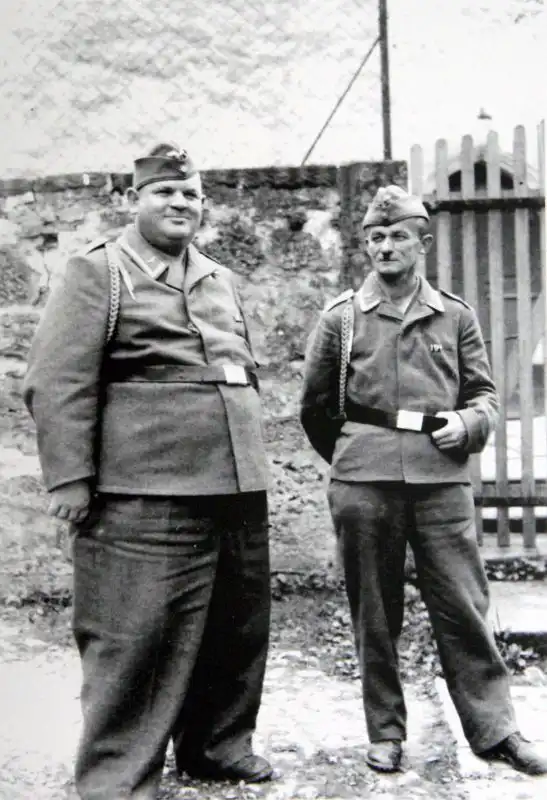
Luftwaffe Ground Support NCOs in Parade Dress (1944)
This characterful 1944 portrait captures two contrasting non-commissioned officers serving in the ground support branch of the German Air Force (Luftwaffe Fliegerhorst-Kompanie) or home defense anti-aircraft artillery (Flak). Standing side by side in a rear-echelon barracks courtyard in Germany, the pair provides a vivid visual study of late-war German manpower demographics far removed from idealized wartime propaganda aesthetics.
By 1944, heavy combat casualties on the Eastern and Western fronts forced the Luftwaffe to assign older recruits, secondary reservists, and individuals with non-standard physical builds to critical airbase maintenance, logistics, and airfield security roles.
Uniform Identification: Fliegerbluse and Marksmanship Awards
Both NCOs wear standardized Air Force field and dress attire tailored for flying and ground personnel:
- Luftwaffe Flight Blouse (Fliegerbluse): Both men wear the standard wool Fliegerbluse, a streamlined tunic designed without exposed lower cargo pockets or decorative front buttons to prevent snagging inside aircraft cockpits or around machinery.
- Marksmanship Lanyard (Schützenschnur): Drape-mounted from the right shoulder strap to the top tunic closure is the formal marksmanship lanyard (Schützenschnur). Awarded for weapons proficiency, this decorative cord featured a silver badge shield at the top and was reserved for formal parade dress or off-duty walking-out dress (Ausgehanzug).
- Collartabs and Piping (Kragenspiegel): Silver NCO braid (Tresse) lines the outer collar edges, paired with rank gulls visible on the collar tabs identifying their non-commissioned officer status.
- Headgear (Schiffchen): Both soldiers wear the standard Luftwaffe sidecap (Fliegermütze) fitted with the national cockade and the swept-wing Luftwaffe eagle emblem.
Late-War Rear-Echelon Service Conditions
Airfield support companies were vital to maintaining Germany's declining aerial defense capabilities during the Allied strategic bombing campaign:
- Airfield Logistics (Fliegerhorst-Personal): Ground crews managed refueling, bomb loading, runway repair, and perimeter defense, allowing specialized pilot cadres to focus exclusively on flight operations.
- Total Mobilization Demographics: The physical contrast between the two soldiers reflects the broad age and fitness spectrum utilized by the Wehrmacht during the final stages of World War II to free younger, fitter personnel for frontline infantry duty.
📍 Location: Germany
📅 Date: 1944
📷 Photographer: Unknown (Private Family / Barracks Photo)
📰 Primary Source: WWII German Air Force Ground Support Archives / Uniform History Collection
Recommended reading:
- Regulations and grades of the Luftwaffe Marksmanship Lanyard (Schützenschnur)
- Design features of the Luftwaffe Fliegerbluse field tunic
- Organization of Luftwaffe Airfield Support Companies (Fliegerhorst-Kompanien)
- Manpower mobilization and reserve personnel in Germany (1944–1945)