Historical July 1942 photograph showing a German Pz.Kpfw. III Ausf. J/L medium tank from the 16th Motorized Infantry Division stationed on 20th Anniversary of October Square in occupied Voronezh.
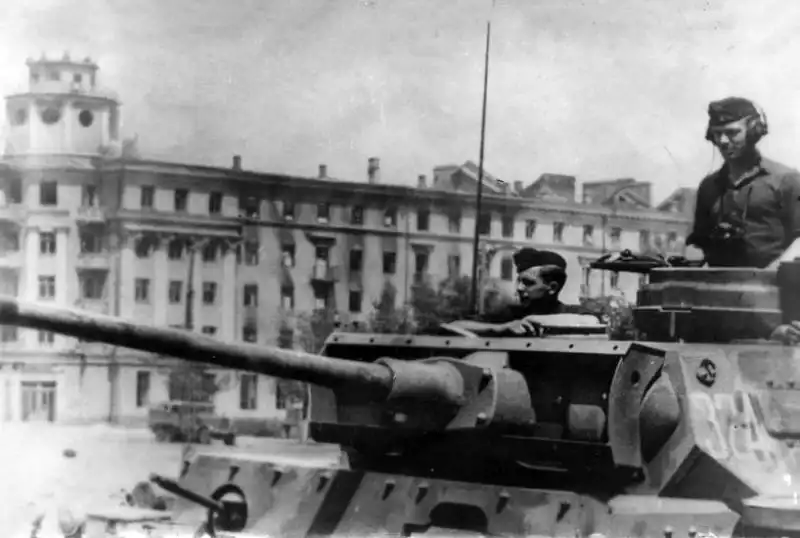
Pz.Kpfw. III Medium Tank in Occupied Voronezh (July 1942)
This striking summer 1942 photograph captures a German medium tank Pz.Kpfw. III (Panzer III) stationed in the center of occupied Voronezh, Soviet Union. The vehicle, assigned to the 16th Motorized Infantry Division (16. Infanterie-Division (mot.)), is positioned on 20th Anniversary of October Square (renamed Lenin Square in 1956), with destroyed municipal architecture visible in the background.
The photo is particularly famous among military historians for its clear depiction of modified turret armor and field maintenance adjustments to the primary gun assembly during Operation Blau.
Technical Identification: Ausf. J vs. Ausf. L and Gun Mantlet Anomalies
Panzer historians frequently debate the precise production variant depicted in this photograph, as it displays transitional armor characteristics:
- Long-Barreled Main Armament (KwK 39 L/60): The tank is equipped with the high-velocity 50 mm KwK 39 L/60 cannon, introduced to counter Soviet T-34 and KV-1 medium and heavy tanks encountered on the Eastern Front.
- Missing Forward Gun Mantlet Shield (Vorpanzer): A key visual detail is the exposed main gun mantlet (Walzenblende). The outer 20 mm spaced armor plate normally bolted to the front of the gun mantlet has been removed or lost in combat, leaving the mounting brackets and bolt holes clearly visible around the barrel sleeve.
- Spaced Armor (Vorpanzer) Configuration: While late-production Ausf. J variants began receiving spaced armor field upgrades, the factory-installed 20 mm spaced armor plate mounted on the upper front hull in front of the driver's vision port strongly indicates a production Ausf. L variant or a late-batch transitional Ausf. J.
- Turret Markings: Tactical numbers ("324") are painted on the turret side, indicating the 3rd Company, 2nd Platoon, 4th Tank within the division's 116th Tank Battalion (Panzer-Abteilung 116).
Battle of Voronezh Context (July 1942)
In July 1942, Axis forces launched Fall Blau, the strategic summer offensive aimed at the oil fields of the Caucasus and the industrial center of Stalingrad:
- Urban Combat in Voronezh: The 16th Motorized Division and the 4th Panzer Army engaged in fierce street fighting to secure the western bank of the Don River and control Voronezh's central transit hubs.
- Stiff Resistance: The Red Army's stubborn defense of the eastern sectors of Voronezh tied down substantial German armored forces, forcing the Wehrmacht to commit heavy armor to city-clearing operations rather than immediate advances south.
📍 Location: Voronezh, Voronezh Oblast, USSR
📅 Date: July 1942
📷 Photographer: Unknown (German Propaganda Company / 16th Division Album)
📰 Primary Source: Feldgrau Archives / Eastern Front Armored Warfare Documentation
Recommended reading:
- Production variants and combat modifications of the Pz.Kpfw. III Ausf. J and Ausf. L
- Development of German spaced armor (Vorpanzer) and 50 mm KwK 39 L/60 tank guns
- Combat operations of the 16th Motorized Infantry Division in Operation Blau (1942)
- The Battle of Voronezh (July 1942) and urban armored warfare on the Don River