Archival summer 1942 photograph documenting the occupation of Voronezh, showing German soldiers at 20th Anniversary of October Square near the Lenin monument.
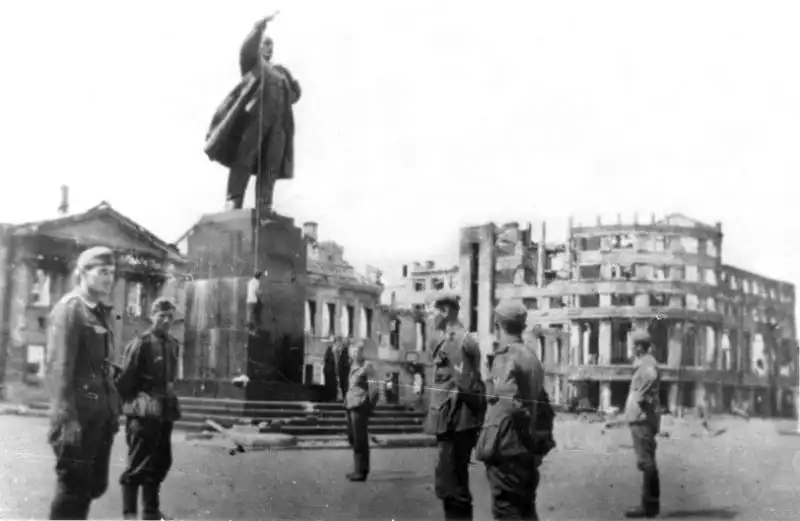
Lenin Monument on 20th Anniversary of October Square, Occupied Voronezh (1942)
This historical archival photograph, taken during the summer of 1942, documents conditions in the central administrative district of occupied Voronezh, Soviet Union. The image shows German soldiers gathered on 20th Anniversary of October Square (renamed Lenin Square in 1956) in front of the monument to Vladimir Lenin, designed by sculptor Nikolai Tomsky and unveiled in 1940. In the background stand the heavy structural ruins of municipal buildings destroyed during the initial battle for the city.
During the 212-day occupation of the city's right bank, central public structures and landmark monuments were utilized by occupation authorities as central gathering points and improvised sites for public execution of local civilians and suspected partisans.
Architectural Context and Historical Significance
The photograph captures key urban landmarks of pre-war Voronezh under military occupation:
- The Lenin Monument (1940): Created by renowned Soviet sculptor Nikolai Tomsky, the bronze statue stood atop a massive granite pedestal. During the German withdrawal in January 1943, the original bronze figure was dismantled and shipped to Germany for scrap metal, but was subsequently re-cast and restored using original molds after the war.
- Municipal Ruins: Visible behind the monument are the damaged facade of the Regional Executive Committee building (left) and the curved architectural front of the Voronezh Hotel (right), both heavily shelled during urban combat in July 1942.
- Occupation Troops: German infantry personnel are visible in the foreground wearing tropical and summer field uniforms (Feldbluse) typical of units assigned to Army Group South during Operation Blau.
The German Occupation of Voronezh (July 1942 – January 1943)
Following the entry of Axis troops into the western sectors of Voronezh in July 1942, the city became a frontline zone divided by the Voronezh River:
- Civilian Toll: Occupation forces established a strict security regimen in the city, carrying out mass deportations, forced labor roundups, and public gallows executions targeting suspected underground resistance members.
- Liberation: The right-bank area of Voronezh remained an active battlefield until January 25, 1943, when the Red Army fully liberated the city during the Voronezh-Kastornoye Offensive, finding over 90% of the city's housing stock destroyed.
📍 Location: Voronezh, Voronezh Oblast, USSR
📅 Date: Summer 1942
📷 Photographer: Unknown (German Soldier Album / Eastern Front Occupation Records)
📰 Primary Source: Voronezh Regional History Museum / State Film and Photo Archive
Recommended reading:
- History and post-war restoration of the Lenin Monument in Voronezh
- Urban damage and civilian history during the 212-day occupation of Voronezh (1942–1943)
- Combat operations of Army Group South on the Don River in Summer 1942
- Liberation of the city during the Voronezh-Kastornoye Offensive (January 1943)