World-famous August 1942 photograph by Emmanuil Evzerikhin depicting the "Children's Khorovod" (Barmaley) fountain standing intact against the burning ruins of Stalingrad Railway Station.
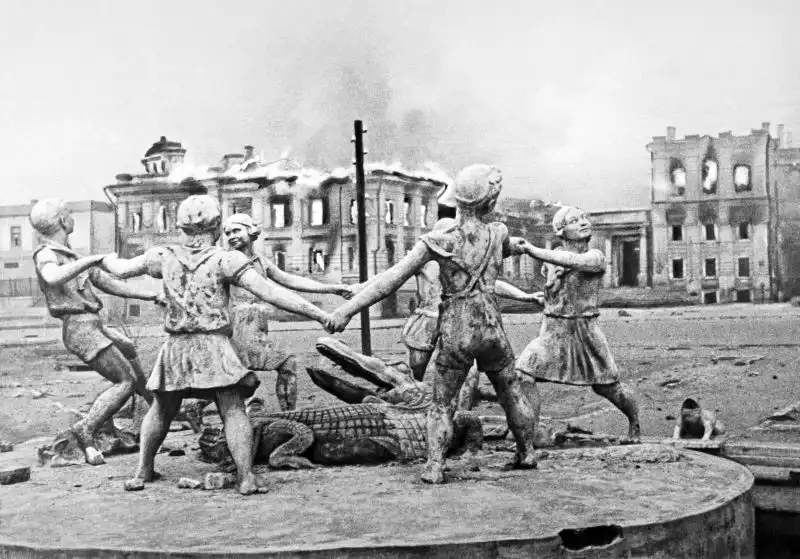
The Barmaley Fountain in Stalingrad After the Luftwaffe Air Raid (August 1942)
This iconic photograph, captured in August 1942 by famed Soviet photojournalist Emmanuil Evzerikhin, is one of the most recognizable visual symbols of the Battle of Stalingrad and World War II. It depicts the intact white plaster sculpture of the "Children's Khorovod" (Barmaley) Fountain standing in Station Square, set starkly against the burning, gutted ruins of the main Stalingrad-I Railway Station following a catastrophic bombing raid by Luftwaffe Generalfeldmarschall Wolfram von Richthofen’s 4th Air Fleet on August 23, 1942.
The striking juxtaposition between the innocence of dancing children and the surrounding total destruction made the image an instant worldwide symbol of resilience and human tragedy during the Eastern Front conflict.
Sculpture Design and Literary Origins
The fountain’s design was directly inspired by Soviet children's literature and pre-war urban architecture:
- Literary Context: Sculpted by Olga Kudryavtseva, the composition illustrates the climax of Korneli Chukovsky's famous 1925 fairy tale Barmaley, where joyful children dance around a friendly crocodile that saved them from a feared pirate. Water spouted from the jaws of the crocodile and surrounding frogs.
- Standard Pre-War Model: Constructed in the 1930s, the fountain was a mass-produced decorative installation installed in several Soviet cities, including Voronezh and Dnipropetrovsk.
- Visual Contrast: Though made of lightweight concrete and plaster, six figures of young Pioneers holding hands survived the initial high-explosive and incendiary carpet bombings that flattened the surrounding municipal quarter.
The Bombing of August 23, 1942, and Historical Aftermath
The photograph captured the immediate aftermath of the single most destructive day in Stalingrad's pre-infantry battle history:
- Air Assault on Station Square: On August 23, 1942, over 2,000 Luftwaffe sorties dropped thousands of tons of explosives on central Stalingrad, killing an estimated 40,000 civilians and turning the transit hub into a combat zone.
- Symbol of Soviet Defense: Photos of the fountain were published globally, becoming shorthand for civilian endurance during the 200-day siege.
- Post-War Fate: The fountain was temporarily restored for post-war victory celebrations, but was demolished in 1951 during the comprehensive architectural reconstruction of Stalingrad (now Volgograd). Modern replicas were later re-installed near the railway station and the Allied Defense Museum.
📍 Location: Station Square, Stalingrad (Volgograd), Volgograd Oblast, USSR
📅 Date: August 23–25, 1942
📷 Photographer: Emmanuil Evzerikhin (TASS Photochronicle)
📰 Primary Source: Russian State Documentary Film and Photo Archive (RGAKFD) / TASS Press Archive
Recommended reading:
- History and design of the Barmaley (Children's Khorovod) Fountain in Stalingrad
- Biography and combat photography of TASS correspondent Emmanuil Evzerikhin
- The Luftwaffe carpet bombing of Stalingrad on August 23, 1942
- Post-war reconstruction of Stalingrad Railway Station and Station Square