Historic photograph of US-built Lend-Lease aircraft—led by a B-25 Mitchell bomber with P-63 Kingcobra fighters and an A-20 Boston—flying over the Verkhoyansk Range in Yakutia, Siberia, 1944.
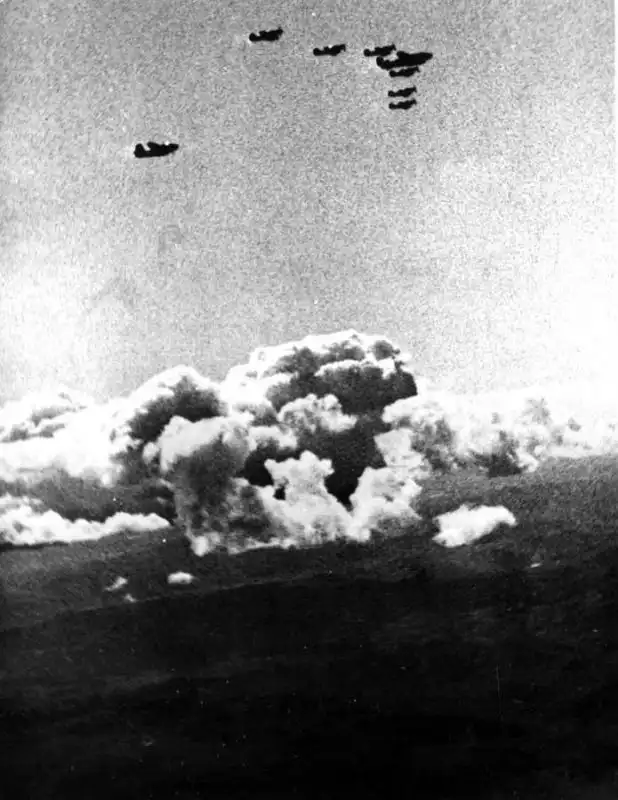
Lend-Lease Aircraft Over the Verkhoyansk Range:
This historic 1944 aerial photograph captures a formation of American-built military aircraft flying over the rugged, snow-capped Verkhoyansk Range in Yakutia, Siberia. These planes were being ferried from the United States to the Soviet Union under the Lend-Lease program to bolster the Red Air Force on the Eastern Front.
To navigate the vast, uncharted, and treacherous sub-arctic wilderness of Northeastern Siberia, ferrying operations utilized a strategic group flight formation:
- Leader Bomber (North American B-25 Mitchell): Flying at the head of the formation, the multi-engine B-25 was equipped with a dedicated navigator and advanced radio-navigation gear to guide single-seat aircraft through poor weather and extreme northern latitudes.
- Fighter Escorts (Bell P-63 Kingcobra): Positioned on the flanks, these single-seat fighters lacked long-range navigation equipment and relied entirely on the leader bomber to reach refuelling airfields across Siberia.
- Rear Element (Douglas A-20 Boston / Havoc): Bringing up the rear, the twin-engine A-20 light bomber provided secondary navigation support and formation stability.
The ALSIB Air Route (Alaska–Siberia Highway of the Sky):
The aircraft in this photo were traveling along the legendary ALSIB (Alaska–Siberia) Air Route, a top-secret 14,000-kilometer (8,700-mile) joint Soviet-American ferrying network established in late 1942:
- Route Trajectory: Planes were manufactured in North American factories, flown to Great Falls, Montana, transferred to American pilots who flew them through Canada to Ladd Field in Fairbanks, Alaska. There, Soviet pilot inspectors accepted the aircraft and ferried them across the Bering Strait, Chukotka, Yakutia, and Krasnoyarsk.
- Extreme Flying Conditions: Soviet aircrews of the 1st Transport Air Division faced temperatures plummeting below -50°C (-58°F), dense cloud cover, and total lack of emergency landing zones over the Siberian tundra and mountain ranges.
- Volume Delivered: Nearly 8,000 aircraft (including P-39 Airacobras, P-63 Kingcobras, B-25s, A-20s, and C-47 transports) were safely delivered via the ALSIB route between 1942 and 1945, forming a crucial pillar of Allied wartime cooperation.
Historical Impact and Legacy:
Despite the difficult grain and contrast of this wartime aerial image, it stands as a powerful visual monument to the logistical effort and unity among the Allied nations during World War II, showing how American industrial capacity and Soviet airmanship combined to defeat a common enemy.
📍 Location: Verkhoyansk Range, Yakutian ASSR, Siberian RSFSR, USSR
📅 Date: 1944
📷 Photographer: Unknown (Soviet Ferry Pilot / Navigator)
Recommended reading:
- History and operations of the ALSIB (Alaska–Siberia) Lend-Lease air route
- Combat performance of the Bell P-63 Kingcobra in Soviet service
- The role of North American B-25 Mitchell bombers as lead navigation aircraft
- Logistics of US war material transport to the Soviet Union during WWII