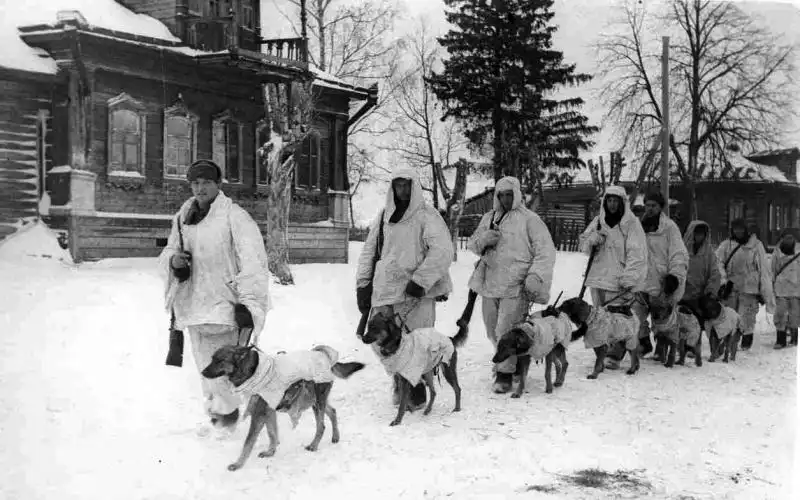
Soviet soldiers of the 1st Army Anti-Tank Dog Detachment marching with anti-tank dogs in winter camouflage cloaks near Moscow, December 1941. Photo by Boris Eyberg.
Red Army Anti-Tank Dog Handlers Near Moscow:
This rare historical photograph, taken by Soviet war correspondent Boris Eyberg in December 1941, depicts soldiers and dogs of the 1st Army Anti-Tank Dog Detachment moving out on a combat mission during the crucial Battle of Moscow.
To maintain stealth in snow-covered rural terrain, both the handlers and their military dogs are outfitted in white winter camouflage cloaks (maskhalaty). Under the command of Major Konstantin Alekseevich Lebedev (born 1889), this specialized unit operated within the 30th Army on the Western Front from October 1941.
Tactics and Deployment of Anti-Tank Dogs (Hounds of War):
Faced with overwhelming German armor during the initial stages of Operation Barbarossa, the Red Army deployed trained explosive-carrying dogs as asymmetric anti-tank weapons:
- Specialized Harness and Charge: Each dog was fitted with a canvas pack carrying approximately 10–12 kg (22–26 lbs) of TNT or plastic explosives and a vertical wooden trigger lever protruding above the dog's back.
- Method of Attack: Dogs were trained to dive directly underneath advancing enemy tanks, where the armor was thinnest (the belly). Upon entering beneath the chassis, the wooden lever bent backward, detonating the explosive charge and destroying both the tank and the dog.
- Combat Effectiveness: According to official military award records for Major K.A. Lebedev, between January and May 1942 alone, anti-tank dogs from his detachment successfully destroyed up to 30 Axis tanks near Moscow.
Evolution into Mine-Detecting and Engineering Units:
As standard anti-tank weaponry (such as PTRD/PTRS anti-tank rifles, artillery, and sticky grenades) became widely available, the tactical necessity for anti-tank dogs diminished.
In late March 1943, the 1st Separate Army Anti-Tank Dog Detachment was merged with the 11th Sled Dog Detachment to form the 1st Separate Regiment of Special Service Dog Trainers, with Major Lebedev serving as deputy commander. Lebedev later commanded the 64th Separate Engineer Mine-Detecting Battalion, transitioning these highly capable military animals from anti-vehicle destruction to landmine clearing and humanitarian demining across liberated Europe.
Historical Source Documentation:
This photograph serves as an important archival document regarding non-conventional Soviet infantry tactics during World War II. It was published in the Soviet press during the defense of the capital:
📍 Location: Moscow Region, RSFSR, USSR
📅 Date: December 1941
📷 Photographer: Boris Eyberg
📰 Primary Sources: Published in Vechernyaya Moskva newspaper, No. 303 (5434), December 24, 1941; Central Archives of the Russian Ministry of Defense (Podvig Naroda database)
Recommended reading:
- Training methods and combat deployment of Soviet military dogs in WWII
- The defense of Moscow (1941–1942) and operations of the 30th Army
- Transition from anti-tank dog units to mine-detection engineer battalions
- Wartime photography of Soviet war correspondent Boris Eyberg