Photograph of a knocked-out German Pz.Kpfw. IV Ausf. G medium tank with a long-barrel KwK 40 gun, destroyed during urban combat by Red Army forces in the USSR, Spring 1943.
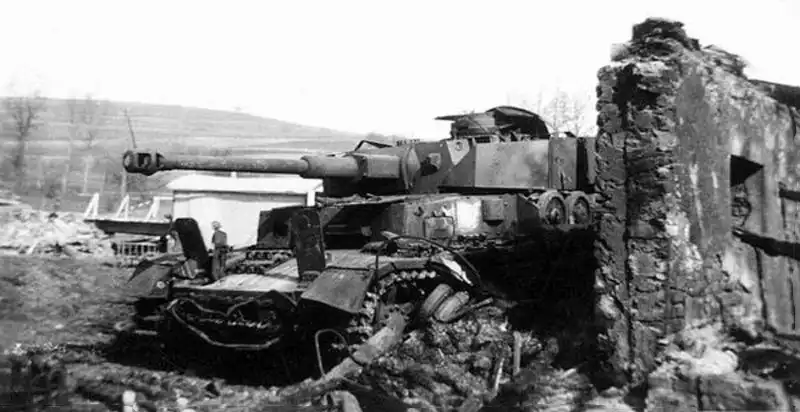
Knocked-Out German Panzer IV Ausf. G in Soviet Ruins:
This striking frontline combat photograph, taken in the spring of 1943, captures the burnt-out hulk of a German Pz.Kpfw. IV Ausf. G (Sd.Kfz. 161/1) medium tank. The vehicle was knocked out by Red Army anti-tank forces during urban fighting in a small Soviet town on the Eastern Front.
The tank lies immobilized beside the crumbling stone wall of a destroyed building, exhibiting catastrophic structural and track damage inflicted during intense close-quarters combat.
Technical Features of the Panzer IV Ausf. G:
Introduced in May 1942, the Ausf. G variant was Germany’s direct response to the armored superiority of Soviet T-34 and KV-1 heavy tanks encountered during Operation Barbarossa:
- Long-Barrel Main Armament: The tank is equipped with the powerful 7.5 cm KwK 40 (L/43 or L/48) anti-tank gun, recognizable by its prominent double-baffle muzzle brake. This gun significantly increased the armor-penetration capability compared to earlier short-barreled Panzer IV variants.
- Upgraded Hull Armor: The frontal hull plate was reinforced with additional 30mm steel plates (appliqué armor), bringing total frontal thickness to 80mm to counter Soviet 76mm anti-tank artillery.
- Commander’s Cupola: The open hatch on the single-piece commander's cupola indicates the crew likely evacuated or was forced to abandon the burning armor after sustaining fatal hits.
Battlefield Analysis and Structural Damage:
A closer inspection of the wreckage reveals the devastating impact of Soviet anti-tank weapons:
- Shattered Running Gear: The left track has been completely blown off, with the front idler wheel and forward road wheels detached from the suspension arms, rendering the vehicle completely immobile.
- Burn Marks and Internal Fire: Dark soot stains around the hull, engine compartment, and turret hatches point to a severe internal ammunition or fuel fire that gutted the tank interior.
- Urban Warfare Context: The cramped setting near village structures highlights the vulnerability of heavy armor in populated areas when deprived of infantry screening, leaving tanks susceptible to Soviet anti-tank rifles (PTRD/PTRS), sticky grenades, and concealed artillery positions.
Spring 1943 Operational Setting:
The spring of 1943 marked a transitional period on the Eastern Front between the Red Army’s triumphant winter counteroffensives (including the Battle of Stalingrad and the Third Battle of Kharkov) and the massive armored clashes at the Kursk Salient in July 1943.
During this lull, Soviet salvage and engineering units systematically documented, cleared, and scrapped hundreds of disabled Wehrmacht armored vehicles abandoned across liberated Soviet territories.
📍 Location: USSR (Eastern Front)
📅 Date: Spring 1943
📷 Photographer: Unknown (Soviet War Correspondent / Military Unit Photographer)
Recommended reading:
- Development and tactical evolution of the Panzer IV Ausf. G on the Eastern Front
- Red Army anti-tank doctrine and urban combat tactics (1942–1943)
- Technical performance of the 7.5 cm KwK 40 L/43 gun against Soviet armor
- The interwar and mid-war destruction of Wehrmacht panzer divisions in Russia