Archival photograph taken on August 8, 1943, showing Supreme Commander Joseph Stalin inspecting a new SU-152 "Zveroboy" heavy self-propelled gun inside the Moscow Kremlin following the Battle of Kursk.
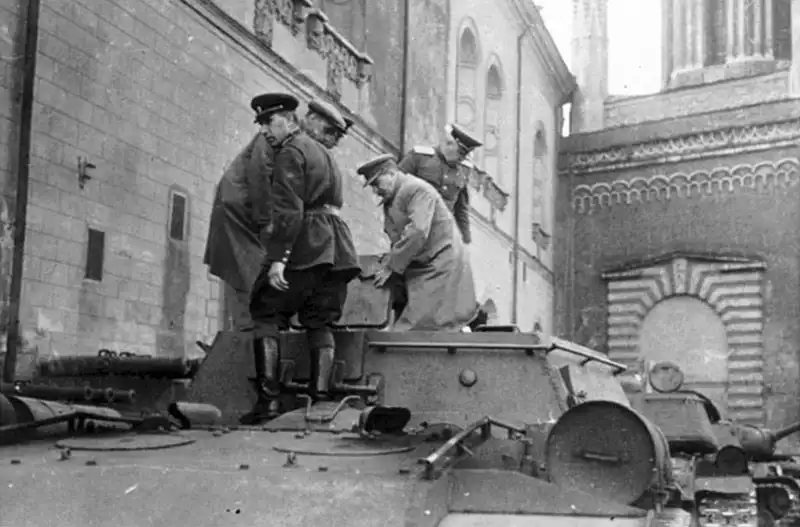
Joseph Stalin Inspecting a SU-152 Heavy Assault Gun in the Kremlin (August 8, 1943)
This remarkable archival photograph, taken inside the Moscow Kremlin on August 8, 1943, captures Soviet Supreme Commander Joseph Stalin personally climbing atop the armored casemate of a new SU-152 heavy self-propelled gun. Accompanied by Red Army officers and test personnel, Stalin, then 64 years old, personally examined the vehicle's commander hatch and Fighting compartment ventilation systems during a government demonstration of frontline armored fighting vehicles.
The inspection took place shortly after the successful operational employment of early SU-152 production units during the pivotal Battle of Kursk.
Technical Specifications and Tactical Significance
Developed on the KV-1s heavy tank chassis at Chelyabinsk Kirov Plant (ChKZ), the SU-152 was engineered to break through heavily fortified defensive lines and counter heavy enemy armor:
- Armament: Equipped with a 152.4 mm ML-20S gun-howitzer, the vehicle fired massive 43.8 kg high-explosive (HE) and armor-piercing projectiles capable of catastrophically disabling enemy heavy armor at combat ranges exceeding 1,000 meters.
- Nickname "Zveroboy" (Beast Hunter): Earning the popular Soviet battlefield moniker "Zveroboy" ("Beast Hunter"), the heavy assault gun proved highly effective against newly introduced German Tiger I heavy tanks, Panther medium tanks, and Elefant heavy tank destroyers during summer 1943 offensives.
- Fighting Compartment Ventilation Improvements: As documented in historical memoirs by Soviet tank designer N. S. Popov, early operational reports indicated powder gas buildup inside the fighting compartment during rapid firing. During the August 8 Kremlin inspection, test driver K. E. Yegorov confirmed to Stalin that improved high-capacity ventilation systems had been engineered into subsequent production series to rapidly clear propellant fumes.
Strategic Production Impact
The success of the SU-152 laid the foundation for the development of Soviet heavy assault artillery throughout the remainder of World War II:
- Evolution to ISU-152: Production of the KV-1s-based SU-152 continued until late 1943, when manufacturing shifted to the modernized ISU-152 built upon the heavier IS-series tank hull.
- Independent Heavy SP Regiments: SU-152 vehicles were organized into specialized Heavy Self-Propelled Artillery Regiments (TSAP), serving as high-command reserve units deployed to break fortified enemy positions across all major Soviet fronts.
📍 Location: Kremlin, Moscow, USSR
📅 Date: August 8, 1943
📷 Photographer: Unknown (TASS / Kremlin Official Photographic Service)
📰 Primary Source: Central Archive of the Russian Ministry of Defense (CAMD) / Kremlin Archival Collection
Recommended reading:
- Development and combat record of the SU-152 heavy self-propelled gun
- Soviet heavy armor in the Battle of Kursk and Operation Kutuzov (1943)
- Tactical role of the 152.4 mm ML-20S gun-howitzer in assault operations
- Evolution of Soviet assault guns: From KV-1s chassis to ISU-152 and ISU-122