Striking 1945 aerial photograph documenting the total devastation of Cologne, Germany, following Allied strategic bombing raids, with the surviving Cologne Cathedral standing amid the ruins along the Rhine.
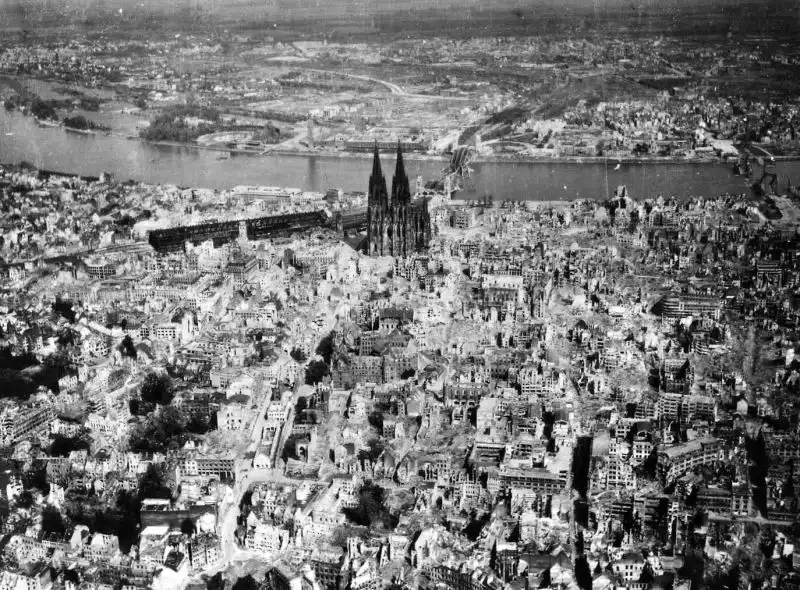
Ruined City of Cologne and Cologne Cathedral from the Air (1945)
This dramatic aerial photograph, taken in 1945 following the Allied capture of the Rhineland, captures the total destruction of Cologne (Köln), Germany. Located on the banks of the Rhine River, the historic industrial center suffered extensive physical devastation during prolonged campaign bombardment by the Royal Air Force (RAF) Bomber Command and the United States Army Air Forces (USAAF).
Standing prominently in the center of the flattened urban landscape is the Gothic Cologne Cathedral (Kölner Dom), its twin spires remaining largely intact despite surrounding total destruction.
Allied Strategic Bombing Campaign and Tactical Targeting
The urban damage documented in the photograph was the result of 262 separate Allied air raids conducted between 1940 and 1945:
- Operation Millennium (1,000-Bomber Raid): On the night of May 30–31, 1942, Cologne became the target of the RAF's first massed 1,000-bomber raid, dropping over 1,400 tons of high explosives and incendiaries that devastated the historic inner city (Altstadt).
- Strategic Navigation Landmark: Allied flight crews intentionally avoided direct carpet-bombing targeting of the Cologne Cathedral. The towering 157-meter twin spires served as a primary visual landmark (aiming point) for bomb navigators aligning approaches toward the adjacent central railway station and the Hohenzollern rail bridge spanning the Rhine.
- Structural Damage to the Cathedral: Despite operational avoidance, the cathedral sustained 14 direct hits by light high-explosive bombs during the war. However, its reinforced medieval Gothic vaulted construction and intervention by local emergency repair teams prevented total vault collapse.
The Fall of Cologne and Post-War Aftermath
The ground capture of the city marked the final operational chapter of the urban campaign in Western Germany:
- Urban Evacuation and Destruction Rate: By the time the US 104th Infantry Division ("Timberwolves") occupied the West Bank of Cologne on March 6, 1945, approximately 95% of the city center was destroyed, and the pre-war population had dropped from 770,000 to under 40,000 residents.
- Rhineland Infrastructure Loss: Retracting German forces demolished all major Rhine bridges, including the Hohenzollern Bridge visible near the cathedral, in an attempt to delay the Allied crossing into the Ruhr industrial pocket.
📍 Location: Cologne (Köln), North Rhine-Westphalia, Germany
📅 Date: Spring 1945
📷 Photographer: Unknown (USAAF / RAF Reconnaissance Archive)
📰 Primary Source: Imperial War Museum (IWM) / National Archives and Records Administration (NARA)
Recommended reading:
- RAF Bomber Command operations: Operation Millennium (The 1942 Cologne 1,000-Bomber Raid)
- Architectural history during wartime: The survival and restoration of Cologne Cathedral (Kölner Dom)
- Allied ground advance into Germany: The capture of Cologne by the US 104th Infantry Division (March 1945)
- Strategic aerial survey: Urban destruction in the Rhineland and Ruhr Basin (1943–1945)