Exceptional archival photograph showing a German Panzer IV crew assembling a cardboard 1/72 scale identification model of a Soviet KV-1 heavy tank in the field for vehicle recognition training.
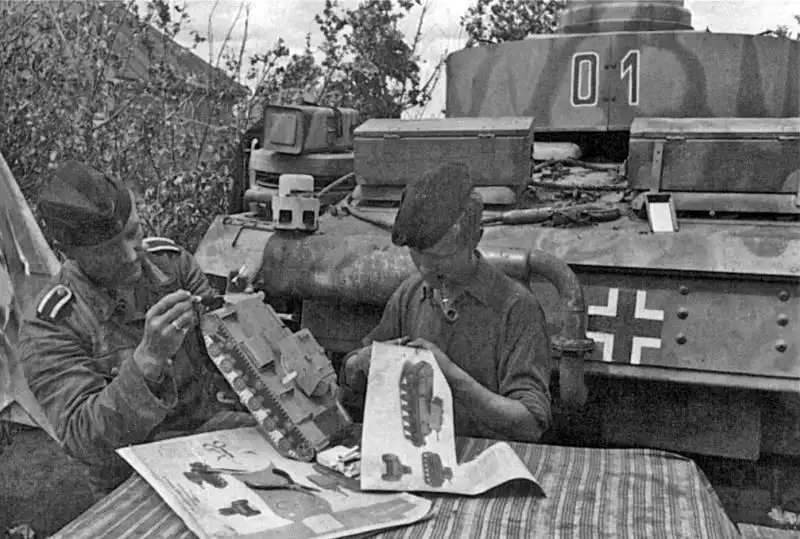
German Panzer Crew Assembling a Soviet KV-1 Paper Model on the Eastern Front (1943)
This remarkable and unusually detailed photograph from 1943 captures members of a German medium tank crew seated at a makeshift field table, meticulous assembling a paper/cardboard scale model of the Soviet KV-1 heavy tank. Positioned immediately behind the soldiers is their command tank, a Panzerkampfwagen IV (turret number "01"), illustrating frontline downtime utilized for military instruction and vehicle recognition training.
On the table, instruction assembly sheets displaying three-view silhouettes are spread out, alongside unbuilt components for a heavy KV-2 assault tank model awaiting assembly.
Vehicle Recognition Training (Erkennungsdienst)
The practice of utilizing 3D scale models served a critical tactical function for Axis and Allied armored forces during World War II:
- Military Identification Kits: During the early stages of Operation Barbarossa, German military publishing houses produced papercraft scale kits (typically in 1/72 or 1/35 equivalent scales) distributed as field visual aids (Erkennungsdienst-Lehrmittel).
- Tactical Silhouette Memorization: By physically cutting, folding, and gluing the characteristic angles of enemy armor—such as the massive turret profile of the KV-1 and the high box turret of the KV-2—tankers and anti-tank gunners memorized key target silhouettes and weak armor points under stress.
- Widespread Allied and Axis Practice: Similar target recognition methodologies were deployed universally across combat theaters. During the Battle of Britain, the British Observer Corps issued 1/72 scale aircraft identification models to civilian spotters along the English Channel. Similarly, Soviet Red Army crews utilized recognition models and technical manuals to study German armor variants, including Pz.Kpfw. III, Pz.Kpfw. IV, and Tiger tanks.
Field Uniforms and Vehicle Details
The photograph offers rich details for military uniform and armored fighting vehicle historians:
- Panzer Crew Uniforms: The soldiers are wearing standard German armored crew field caps (Schiffchen and berets) and wool wrap jackets (Sonderbekleidung der Panzertruppen) fitted with pink-piped (Rosa) armor branch shoulder boards.
- Command Panzer IV (Tactical Number "01"): The background tank displays the prominent single-digit tactical number "01", indicating a regimental or battalion commander's vehicle (Stabsfahrzeug), alongside standard Balkan Cross (Balkenkreuz) national markings on the rear hull.
📍 Location: Eastern Front, USSR
📅 Date: 1943
📷 Photographer: Unknown (German Army / Propaganda Company Photo Archive)
📰 Primary Source: WWII Scale Modeling Historical Archives / Federal Archives (Bundesarchiv)
Recommended reading:
- History and development of WWII military vehicle recognition models (Erkennungsdienst)
- Combat performance of Soviet heavy armor: KV-1 and KV-2 tanks on the Eastern Front
- Field training and tactical manuals of German Panzer crews (1941–1943)
- Historical scale modeling: Papercraft and cardboard tank kits in World War II