Historic 1942 photograph of three German airmen graves on occupied Soviet territory, marked with wooden crosses and propeller hubs from their crashed twin-engine bomber.
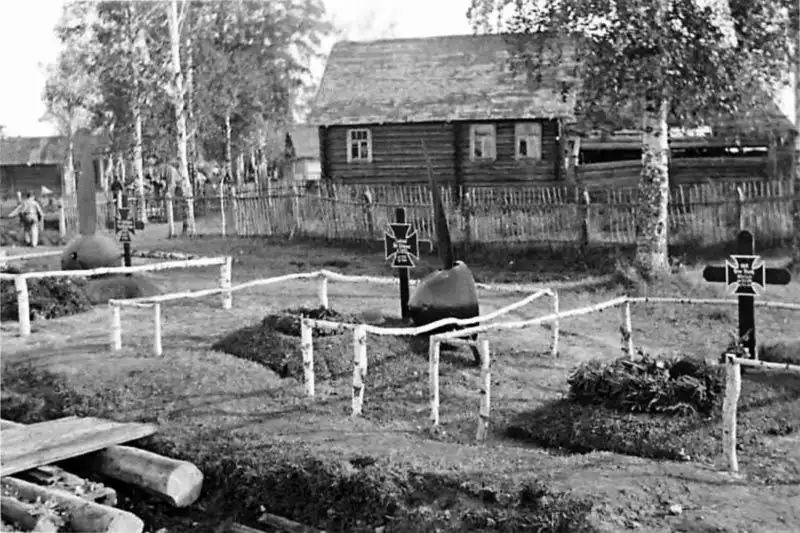
Graves of a German Luftwaffe Bomber Crew on the Eastern Front (1942)
This poignant archival photograph from 1942 shows a field burial site for three Luftwaffe pilots on the Eastern Front killed during operations in the occupied territories of the Soviet Union.
Located in a rural village setting, the field cemetery features wooden military crosses flanked by aircraft wreckage components—specifically propeller hubs and blades recovered from the crashed aircraft to serve as memorial markers.
Equipment, Uniforms, and Visual Features
The imagery provides significant visual clues regarding Luftwaffe burial customs and the potential aircraft type involved in the crash:
- Propeller Hub Grave Markers: The central feature of two graves consists of metal propeller spinners (hubs) with attached blades salvaged from the downed aircraft. This was a widespread custom among Luftwaffe ground personnel to honor fallen aircrews.
- Aircraft Identification Clues: The profile of the propeller hubs and pitch-control blade assemblies strongly suggests a twin-engine German aircraft, such as the Junkers Ju 88, Heinkel He 111, or Dornier Do 217 bomber series.
- Crew Size Discrepancy Analysis: The presence of exactly three graves raises historical possibilities regarding the casualty count. Standard medium bombers like the Ju 88 or He 111 typically carried a four-man crew (pilot, navigator/bombardier, radio operator, and gunner). Three graves indicate either a specialized three-man reconnaissance/night-fighter crew configuration (such as a Messerschmitt Bf 110) or that a fourth crew member survived the crash via parachute evacuation.
- Enclosure and Location: The burial plot is carefully enclosed with a decorative fence crafted from local birch branches, set against the backdrop of traditional timber village homes.
Luftwaffe Casualties on the Eastern Front in 1942
During the intense aerial campaigns of 1942, including operations over Stalingrad, the Rzhev salient, and the Don region, the German Luftwaffe suffered heavy attrition in both flight crews and medium bombers. Field burials near frontline airfields or crash sites were frequently photographed by unit comrades before formal casualty reporting to the High Command.
📍 Location: Occupied Territory, USSR
📅 Date: 1942
📷 Photographer: Unknown
📰 Primary Source: Historical military aviation archive
Recommended reading:
- Luftwaffe aircraft analysis: Design features of Ju 88 and He 111 propeller assemblies
- Aircrews on the Eastern Front: Standard crew compliments and casualty rates of German bomber units in 1942
- Wartime burial customs: Field cemeteries and grave markers of the German armed forces in the USSR
- Eastern Front air war: Strategic bomber operations and losses during the campaigns of 1942