Historic photograph of German aircrew posing beside their Focke-Wulf Fw 189 Uhu reconnaissance aircraft following a belly landing in snow on the Eastern Front in winter 1942.
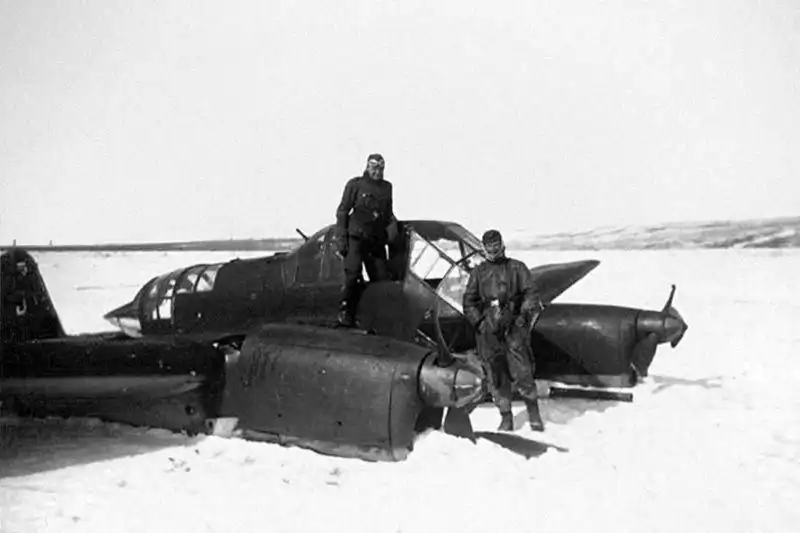
Focke-Wulf Fw 189 Uhu (Rama) Reconnaissance Plane After Forced Landing in Snow (Winter 1942)
This detailed aviation photograph from winter 1942 captures a German Luftwaffe aircrew posing alongside their Focke-Wulf Fw 189 Uhu tactical reconnaissance aircraft following a successful forced belly landing on a snow-covered field in the occupied Soviet Union.
Officially nicknamed Uhu (Owl) by the manufacturer and Luftwaffe personnel, the twin-boom aircraft earned the iconic Russian nickname "Rama" (Frame) among Red Army soldiers due to its distinctive dual-fuselage silhouette hanging overhead along the Eastern Front.
Equipment, Markings, and Visual Features
The photograph offers key visual technical details regarding Luftwaffe tactical reconnaissance operations and emergency winter landings:
- Twin-Boom Aircraft Layout: The Fw 189 featured a central fully glazed crew gondola flanked by two tail booms housing Argus As 410 air-cooled V12 engines. The extensive glass canopy provided the three-man crew with exceptional all-around visibility for artillery spotting and photographic reconnaissance.
- Forced Belly Landing Indicators: The aircraft rests directly on its central fuselage belly in deep snow without landing gear extended. The propeller blades on the Argus engine nacelles show visible bending at the tips, proving the propellers were spinning upon impact with the snowfield.
- Exceptional Structural Survivability: Renowned for its extreme agility and low wing-loading, the Fw 189 could routinely survive severe anti-aircraft hit damage and even mid-air collisions, frequently enabling crews to execute controlled forced landings like the one pictured.
- Aircrew Winter Flight Gear: The two crewmen pose calmly beside the fuselage wearing heavy heavy leather winter flying suits, flight helmets, and insulated boots, indicating no immediate casualties occurred during the emergency touchdown.
The Tactical Impact of the Fw 189 "Rama" on the Eastern Front
Deployed extensively from 1941 through 1944, the Fw 189 served as the primary short-range eyes of the German Army (Heer). Operating at low to medium altitudes, it directed artillery fire, monitored Red Army troop movements, and coordinated immediate air strikes by Ju 87 Stuka dive bombers. Due to its threat to troop concentrations, Soviet fighters and anti-aircraft crews prioritized shooting down the "Rama" above almost all other tactical aircraft types.
📍 Location: Occupied Territory, USSR
📅 Date: Winter 1942
📷 Photographer: Unknown
📰 Primary Source: Historical Luftwaffe aviation archive
Recommended reading:
- Aviation design analysis: Structural layout and durability of the Focke-Wulf Fw 189 Uhu
- Tactical air reconnaissance: How the Fw 189 "Rama" directed artillery fire on the Eastern Front
- Soviet counter-measures: Red Army infantry and fighter tactics against German reconnaissance aircraft
- Winter operational survival: Emergency landing procedures and winter gear of Luftwaffe aircrews