Historic 1945 studio portrait of Soviet garrison patrol soldiers in Germany, armed with a PPS-43 submachine gun and a rare trophy Italian Mannlicher-Carcano carbine.
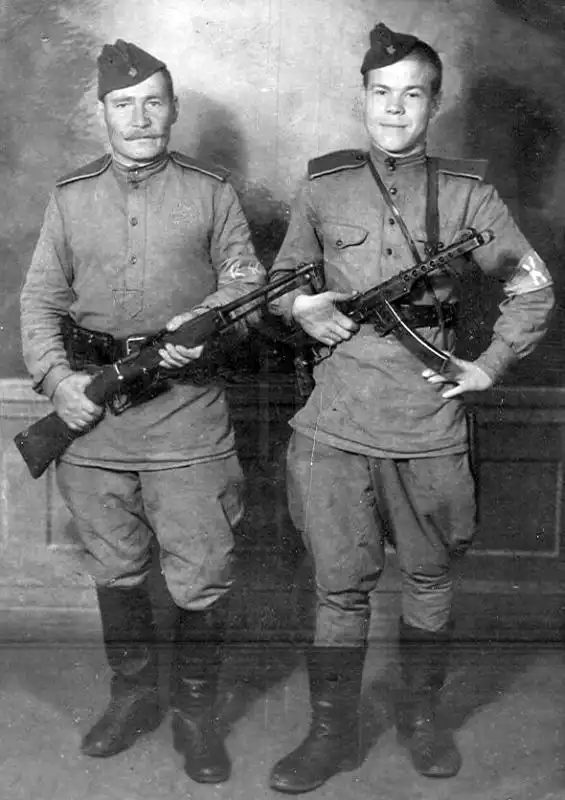
Soviet Commandant Patrol Guarding Occupied Germany with an Italian Carcano Carbine (1945)
This remarkable studio portrait from 1945 captures two Soviet Red Army soldiers serving in a local military commandant's office (garrison patrol) within the Soviet occupation zone of Germany following the defeat of Nazi Germany.
Beyond the characteristic armbands designating guard duty, the photograph is particularly notable for the highly unusual firearm held by the veteran soldier on the left: a Italian forces captured by the Red Army 6.5mm or 7.35mm Mannlicher-Carcano carbine (likely an M1891, M38, or M1891/38 variant) complete with an under-barrel folding needle bayonet.
Equipment, Uniforms, and Visual Features
The image provides a fascinating look at the mix of standard-issue and captured trophy small arms utilized by Red Army rear-security patrols at the close of World War II:
- Commandant Patrol Armbands: Both soldiers wear official armband identifiers on their left sleeves, signaling their authority as garrison patrol personnel responsible for maintaining order, guarding public facilities, and registering disarmed Axis personnel.
- Trophy Mannlicher-Carcano Carbine: The soldier on the left holds an Italian Carcano folding-bayonet carbine. Italian weapons entered Soviet possession through several historical channels, most notably following the September 1943 Italian armistice when the German Wehrmacht disarmed Italian forces and redistributed hundreds of thousands of Carcano rifles to German home-guard (Volkssturm), police, and rear-echelon units in Germany.
- PPS-43 Submachine Gun: The younger soldier on the right is armed with the standard 7.62mm PPS-43 submachine gun, highly regarded for its compact stamped-steel construction, reliability, and effectiveness in urban security patrols.
- Uniform Standards: Both men wear late-war Model 1943 field tunics (gimnastyerka) with stand-up collars, shoulder boards (pogony), pilotka side caps, and high leather boots.
Small Arms Diversity in the Post-War Occupation Zone
Following the fall of Berlin and the capitulation of Germany in May 1945, Soviet garrison commands systematically disarmed military and paramilitary formations across the occupation zone. Millions of foreign rifles, carbines, and pistols were collected, occasionally leading to unique photographic record entries where Soviet troops posed with or temporarily utilized non-standard trophy weaponry for routine patrol service.
📍 Location: Soviet Occupation Zone, Germany
📅 Date: 1945
📷 Photographer: Unknown
📰 Primary Source: Historical small arms archive
Recommended reading:
- Small arms history: Design features and variations of the Italian Mannlicher-Carcano carbine series
- Trophy weapons in the Red Army: Capture, cataloging, and field use of Axis small arms in 1945
- Post-war administration: The structure and duties of Soviet military commandant offices in occupied Germany
- Automatic infantry weapons: Operational deployment of the PPS-43 submachine gun in garrison service