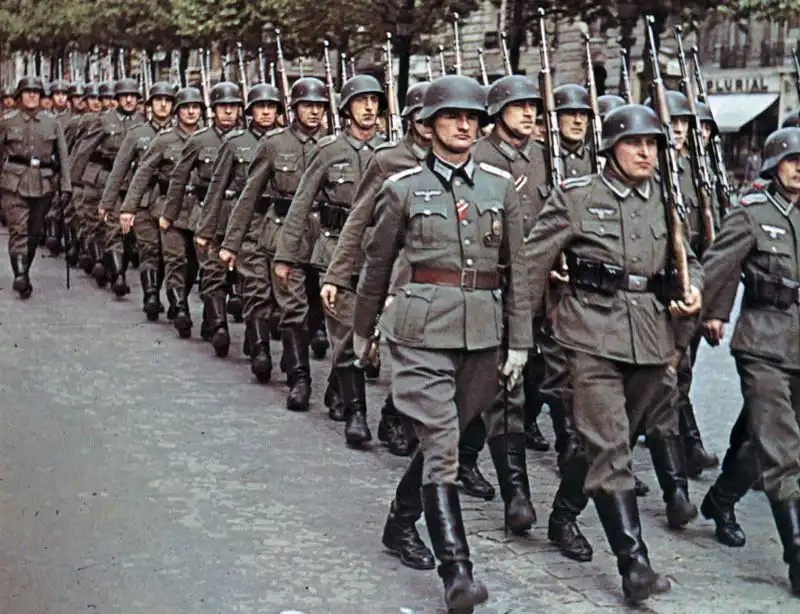
A German military column marches along the Champs-Élysées in 1942. A striking color image symbolizing power, control, and occupation in the heart of Paris.
Power on Display in the Heart of Paris:
This color photograph captures a column of German troops moving along the Champs-Élysées in occupied Paris in 1942.
The setting is one of the most iconic avenues in the world — a symbol of French identity, culture, and national pride.
Now, it is filled with foreign soldiers.
The message is unmistakable: Paris is under control.
The Symbolism of the Champs-Élysées:
The Champs-Élysées is not just a street — it is a national stage.
Traditionally associated with:
- Military parades
- National celebrations
- French victories
Seeing German troops marching here carried deep symbolic weight.
It was not only a military presence — it was a visual statement of domination.
The Soldier in the Foreground:
In the foreground stands a German infantry officer whose uniform tells a story of another front — the Eastern Front.
Visible decorations include:
- The Eastern Front Medal (Winter 1941–1942) — awarded for participation in the brutal winter campaign against the Soviet Union
- A wound badge, indicating he had been seriously injured in combat
- Additional military decorations
Among soldiers, the Eastern Front Medal earned a grim nickname:
“Frozen Flesh Medal.”
It reflected the extreme suffering endured during the winter campaign — cold, hunger, and massive casualties.
From the Eastern Front to Paris:
This detail creates a powerful contrast.
The same army:
- Fighting a brutal war in the East
- Suffering enormous losses
- Enduring extreme conditions
Is also:
- Occupying Western Europe
- Marching through Paris
- Maintaining control over civilian populations
The officer embodies both realities at once.
Occupation as Spectacle:
German presence in Paris was not hidden — it was deliberately visible.
Military columns like this served several purposes:
- Reinforcing authority
- Demonstrating strength
- Reminding civilians of control
Even without violence, such scenes carried psychological weight.
The occupation was meant to be seen.
The Photographer – André Zucca:
This photograph was taken by André Zucca, known for his rare color images of occupied Paris.
Working with the German publication Signal, he had access to Agfacolor film, allowing him to capture unusually vivid scenes of wartime life.
His work remains controversial.
While technically remarkable, many of his images present a composed, controlled version of reality — one that can soften the perception of occupation.
A City Under Watch:
Even when no direct conflict is visible, the reality is clear.
Behind this scene:
- Paris is occupied
- Civil liberties are restricted
- Resources are controlled
- Resistance is suppressed
The calm order of the marching troops hides a deeper tension.
The Contrast of War:
This image brings together multiple layers of World War II:
- Brutality of the Eastern Front
- Order and control in Western Europe
- Everyday visibility of occupation
It shows how war could exist simultaneously as:
👉 Chaos and suffering
👉 Discipline and control
Historical Photograph Information:
Location: Paris, France
Date: 1942
Photographer: André Zucca
Recommended Books on Occupation and the German Army:
1. When Paris Went Dark — Ronald C. Rosbottom
A detailed look at life under occupation.
2. France Under the Germans — Richard Vinen
Explains the structure of German control.
3. The Eastern Front 1941–1945 — Omer Bartov
Insight into the brutal realities behind the medal seen in the image.
4. The Wehrmacht: History, Myth, Reality — Wolfram Wette
A deeper understanding of the German army’s role in WWII.