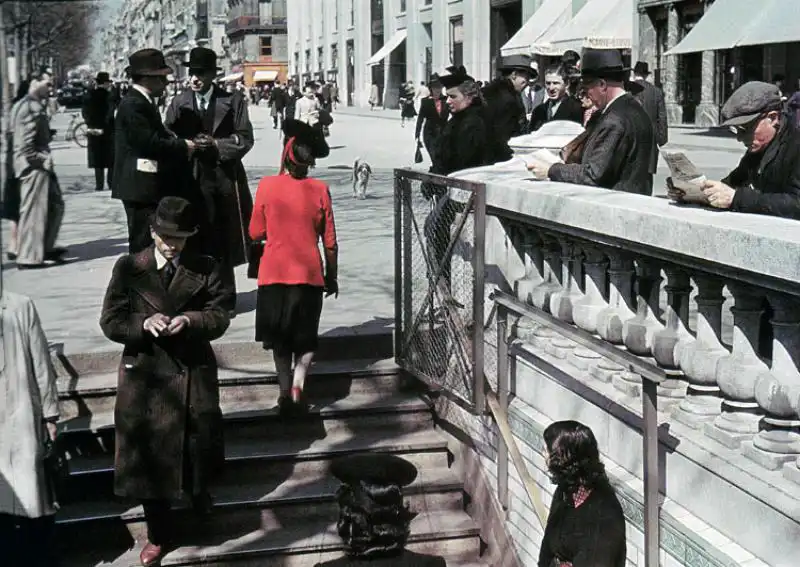
Ordinary civilians walk the streets of occupied Paris, 1942. A rare color photograph revealing how daily life continued under the shadow of German control.
A City That Refused to Stop:
This color photograph captures ordinary Parisians going about their daily lives in 1942, during the German occupation of France.
People walk, talk, and move through the streets as if nothing extraordinary is happening.
There are no visible signs of violence. No destruction. No chaos.
And yet — this is a city under foreign control.
The Surface of Normality:
One of the most striking aspects of occupied Paris was how normal it could look.
Despite the war:
- People went to work
- Shops remained open
- Streets stayed busy
- Social life continued
Even leisure activities persisted — cafés, cinemas, and walks through the streets.
Historians note that daily life, at least on the surface, continued in a relatively familiar rhythm, even under occupation.
This created a powerful illusion:
👉 A living, functioning city
👉 Hiding a controlled and restricted reality
Life Under Constraints:
Beneath this calm exterior, everyday life was shaped by strict limitations.
Parisians faced:
- Food shortages and rationing
- Limited access to fuel and goods
- Economic pressure from occupation policies
The German authorities extracted resources from France, contributing to scarcity and hardship.
So while the streets looked alive, survival required constant adaptation.
A Carefully Balanced Reality:
This image represents a paradox that defined occupied Paris.
On one hand:
- Well-dressed civilians
- Clean streets
- A sense of continuity
On the other:
- Foreign troops present throughout the city
- Political repression
- Social inequality
Photographs like this show how horror and normal life coexisted side by side, often in the same moment.
The Photographer – André Zucca:
This photograph was taken by André Zucca, one of the few photographers who documented occupied Paris in color.
Working for the German propaganda magazine Signal, he had access to rare Agfacolor film, which allowed him to produce vivid images of everyday life.
His work is controversial.
Why?
Because many of his photographs show a Paris that looks calm, stylish, even cheerful — a version of reality that does not fully reflect the suffering behind the scenes.
The Power of What Is Not Shown:
This image is powerful not because of what it reveals — but because of what it hides.
There are no:
- Arrests
- Deportations
- Hunger
- Violence
And yet all of these were part of life under occupation.
Censorship and access shaped what could be photographed, meaning that even honest images often show only part of the truth.
A City Living in Two Realities:
Occupied Paris existed in two parallel worlds:
Visible world:
- Movement, conversation, routine
- Fashion and urban life
- A sense of stability
Hidden world:
- Fear and surveillance
- Shortages and inequality
- Political control and repression
This photograph belongs to the first — but cannot be understood without the second.
Historical Photograph Information:
Location: Paris, France
Date: 1942
Photographer: André Zucca
Recommended Books on Daily Life in Occupied Paris:
1. When Paris Went Dark — Ronald C. Rosbottom
A vivid account of everyday survival under occupation.
2. France Under the Germans — Richard Vinen
Explains the structure of control and daily life.
3. Paris in the Dark Years — Thomas J. Fleming
Focuses on civilian experiences.
4. The Collapse of the Third Republic — William L. Shirer
Provides historical context of France’s defeat.