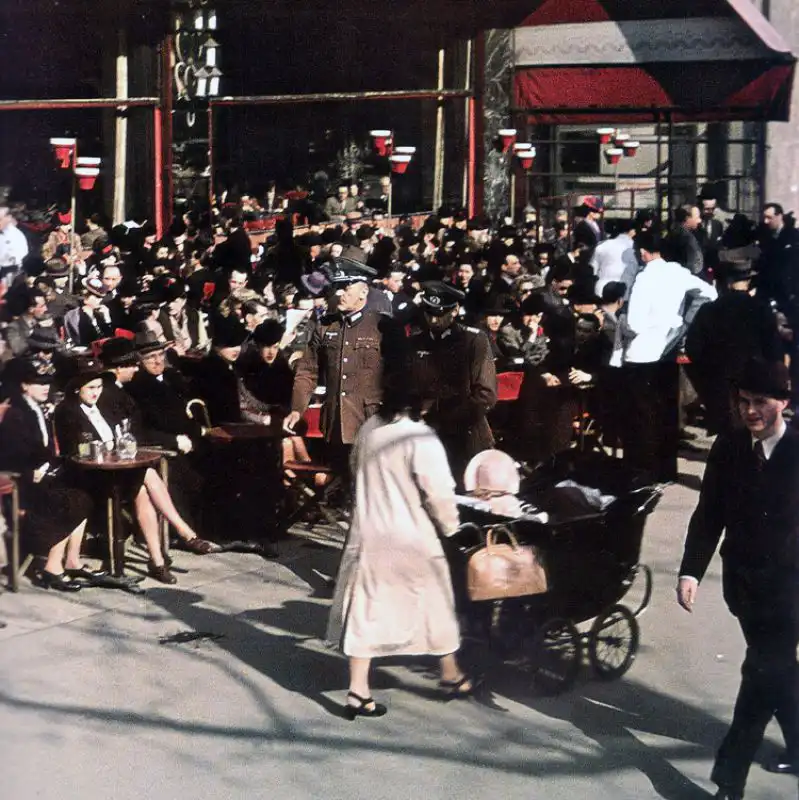
German Wehrmacht officers pass by a crowded Parisian café, 1942. A striking color image revealing the uneasy coexistence of civilians and occupiers during World War II.
A Calm Street Under Occupation:
This vivid color photograph captures German Wehrmacht officers walking past a crowded street café in occupied Paris in 1942.
At first glance, the scene looks almost peaceful:
- People sit at café tables
- Conversations continue
- Life seems ordinary
But the presence of uniformed German officers immediately changes the meaning of the moment.
This is not normal life — this is life under occupation.
The Illusion of Normality:
One of the most disturbing aspects of this image is how normal everything appears.
Cafés are full. People are relaxed. No visible fear.
Yet historians emphasize that daily life in Paris continued largely on the surface, even under German control. Civilians worked, socialized, and maintained routines despite the occupation.
This creates a powerful illusion:
👉 A city that looks alive
👉 But is politically and socially constrained
German Presence in Everyday Life:
By 1942, German soldiers and officers were a constant part of Parisian streets.
They were not hidden — they were visible, integrated into daily urban life:
- Walking through public spaces
- Visiting cafés and restaurants
- Interacting with civilians
Photographs from this period often show German officers casually mingling among Parisians, reinforcing the idea of a controlled but functioning city.
But this visibility also served another purpose — it reminded everyone who was in control.
The Café Culture of Paris:
Parisian cafés were more than just places to eat or drink.
They were:
- Social hubs
- Centers of conversation and news
- Symbols of French urban identity
Even during the occupation, cafés remained open and active.
But their meaning changed:
- They became spaces of adaptation
- Places where civilians and occupiers coexisted
- Zones where appearances had to be carefully maintained
Sitting at a café did not mean freedom — it meant survival within limits.
The Photographer – André Zucca:
This photograph was taken by André Zucca, one of the most controversial photographers of World War II.
He worked for the German propaganda magazine Signal, which aimed to present a favorable image of life under occupation.
Thanks to this position, Zucca had access to rare Agfacolor film, allowing him to produce unusually vivid color images of wartime Paris.
His photographs often show:
- Well-dressed civilians
- Busy streets
- Peaceful scenes
But critics argue that this visual calm can hide the harsher realities of occupation.
A Controlled Reality:
This image reflects a carefully balanced reality:
- Civilians continue daily life
- German officers move confidently through the city
- No open conflict is visible
Yet beneath the surface:
- Food shortages were widespread
- Civil liberties were restricted
- Fear and inequality shaped everyday life
The absence of visible tension does not mean the absence of oppression.
A City Divided Into Layers:
Occupied Paris existed on multiple levels at once:
Visible layer:
- Cafés, fashion, social life
- Movement and conversation
- A sense of continuity
Hidden layer:
- Surveillance and control
- Economic hardship
- Political repression
This photograph sits exactly at the intersection of those two realities.
Historical Photograph Information:
Location: Paris, France
Date: 1942
Photographer: André Zucca
Recommended Books on Occupied Paris:
1. When Paris Went Dark — Ronald C. Rosbottom
A detailed account of daily life under occupation.
2. France Under the Germans — Richard Vinen
Explores the social and political structure of occupied France.
3. Paris in the Dark Years — Thomas J. Fleming
Focuses on the experiences of ordinary Parisians.
4. The Collapse of the Third Republic — William L. Shirer
Provides broader historical context.