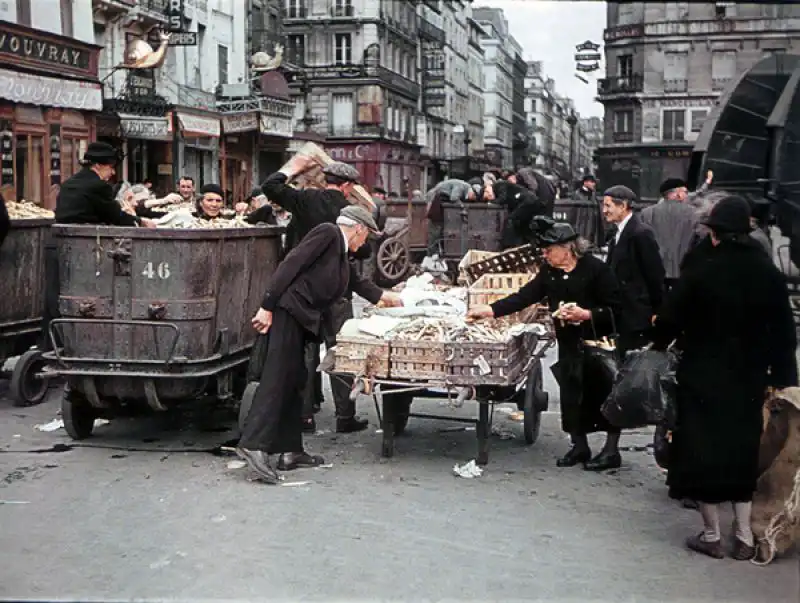
Starving civilians in occupied Paris search through garbage for food, 1942. A rare color image exposing the harsh reality behind wartime “normality.”
Hunger Behind the Facade
This disturbing color photograph shows civilians in occupied Paris searching through garbage bins for expired food in 1942.
At first glance, it is just a moment of poverty.
But in reality — it’s a direct consequence of occupation, shortages, and a system that slowly pushed people to the edge of survival.
Paris Was Not Starving — But It Was Starving:
Officially, Paris was not a famine city.
In reality, things were much darker:
- Food was strictly rationed
- Supplies were unreliable
- Prices constantly increased
- The poorest suffered the most
Even basic products — bread, meat, milk — were limited or unavailable.
People received ration cards, but those often meant nothing when shelves were empty.
Rationing System and Survival:
From 1940 onward, the German occupation imposed a rigid rationing system across France.
Key facts:
- Meat: sometimes as little as ~90 grams per week
- Butter, cheese, eggs — almost a luxury
- Milk — only for small children
- Substitute foods (ersatz) became common
For many Parisians, especially the poor:
- Official rations were not enough
- Black market prices were insane
- Starvation became a real threat
And this is where scenes like the one in the photograph come from.
Why People Searched Trash:
This image isn’t an exception. It is a symptom of the system.
People searched garbage because:
- Food waste still existed (especially from better-off citizens or German units)
- Expired or spoiled food was still edible if you are truly hungry
- There was simply no other option
Occupation economy worked like this:
👉 Best resources → Germany
👉 Remaining → ration system
👉 Real survival → informal networks, the countryside, and garbage
The Photographer – André Zucca:
The photograph was taken by André Zucca, one of the most controversial chroniclers of occupied Paris.
He worked with the German magazine Signal and used color film — rare for the time.
His work often shows:
- Cafés
- Fashion
- Calm streets
But images like this one reveal the other side — the one usually hidden.
The Dark Side of “Normal Life”:
Here is the disturbing paradox:
- Some photos show relaxed Parisians in cafés
- Others — like this — show people digging in trash
Both are real.
Life under occupation was split:
- A visible layer of “normality”
- A hidden layer of deprivation and humiliation
And the second one was way more widespread than it looked.
The Reality of Occupied Paris:
Under German control, Paris experienced:
- Constant shortages and economic pressure
- Strict control over food distribution
- Black markets accessible only to the wealthy
- Daily humiliation and inequality
Finding food became the main obsession of civilians.
And when even that failed — people turned to garbage bins.
Historical Photograph Information:
Location: Paris, France
Date: 1942
Photographer: André Zucca
Recommended Books on Hunger and Occupation:
1. When Paris Went Dark — Ronald C. Rosbottom
2. France Under the Germans — Richard Vinen
3. The Collapse of the Third Republic — William L. Shirer
4. Paris in the Dark Years — Thomas J. Fleming