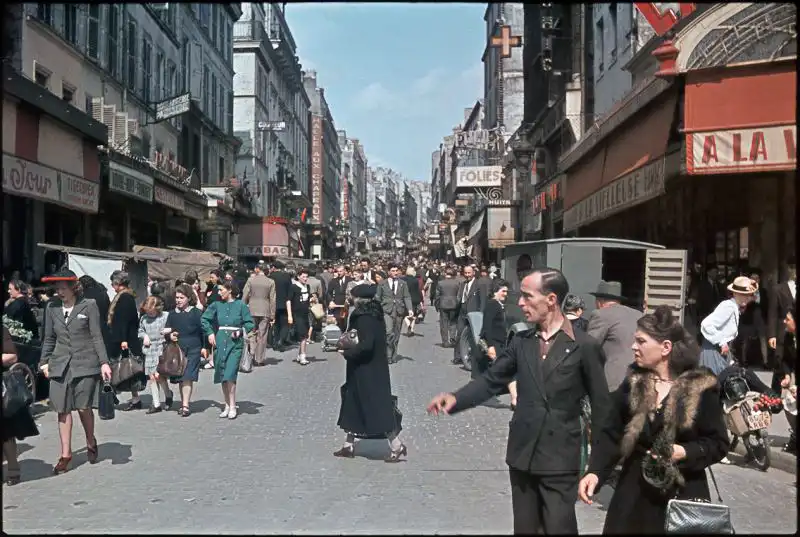
Civilians walk through Belleville in occupied Paris, 1942. A rare color photograph capturing everyday life in a working-class district under German control.
A Quiet Day in Belleville:
This color photograph shows civilians walking through the Belleville district of Paris on a sunny day in 1942, during the German occupation.
At first glance, the scene feels calm and almost carefree:
- People strolling through the streets
- Bright daylight softening the atmosphere
- No visible signs of conflict
But this peaceful moment exists within a city under foreign rule.
Beyond the Elegant Paris:
Belleville was very different from central Paris.
Unlike the grand boulevards and famous cafés, this district was known for:
- Its working-class population
- Dense housing and modest living conditions
- A diverse and often immigrant community
It represented a more real, everyday Paris — far from the polished image shown in propaganda or tourist imagery.
Life in a Working-Class District:
During the occupation, districts like Belleville faced particular challenges.
Residents often experienced:
- Greater economic hardship
- More severe impact from food shortages
- Limited access to black market goods
For many people here, survival required constant adaptation.
Daily routines continued, but under pressure:
- Finding food became a priority
- Work opportunities were unstable
- Living conditions became increasingly difficult
The Illusion of Peace:
What makes this photograph powerful is its deceptive calm.
There is no visible fear. No soldiers. No destruction.
And yet:
- The city is occupied
- Resources are controlled
- Freedom is limited
This contrast creates a quiet tension — a reminder that even peaceful moments were shaped by the realities of war.
The Photographer – André Zucca:
The image was captured by André Zucca, one of the few photographers documenting occupied Paris in color.
Working with the German publication Signal, he had access to Agfacolor, allowing him to produce unusually vivid images.
His work often emphasizes:
- Everyday life
- Calm urban scenes
- A sense of continuity
However, it is also controversial, as it can present a version of reality that downplays the hardships and repression of the occupation.
A City Living Two Lives:
Belleville in 1942 reflects the broader reality of occupied Paris.
On the surface:
- People walk, talk, and live their lives
- The city appears stable and functioning
Beneath the surface:
- Shortages and poverty persist
- Social inequality deepens
- Occupation shapes every aspect of life
This duality defines the image.
The Power of Ordinary Moments:
Unlike dramatic war photographs, this image captures something quieter — and perhaps more revealing.
It shows how:
- War becomes part of everyday life
- People adapt to extraordinary circumstances
- Normality continues, even when it is no longer truly normal
In that sense, the photograph is not about events — it is about conditions.
Historical Photograph Information:
Location: Paris, France
Date: 1942
Photographer: André Zucca
Recommended Books on Daily Life in Occupied Paris:
1. When Paris Went Dark — Ronald C. Rosbottom
A detailed account of civilian life under occupation.
2. France Under the Germans — Richard Vinen
Explains economic and social realities.
3. Paris in the Dark Years — Thomas J. Fleming
Focuses on ordinary Parisians.
4. The Collapse of the Third Republic — William L. Shirer
Provides broader historical context.