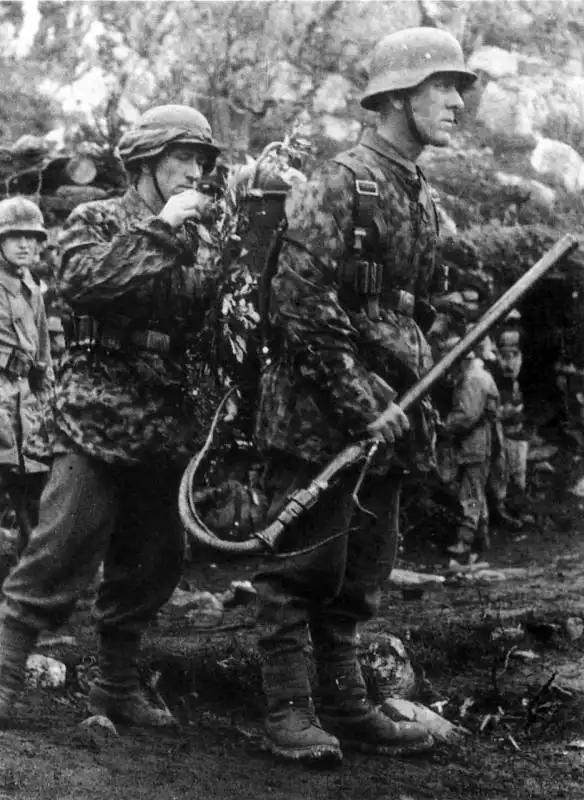
German combat engineers (Pioniere) equipped with the heavy Flammenwerfer 35 backpack flamethrower during the Norwegian Campaign, April–May 1940.
Wehrmacht Combat Engineers and the Flammenwerfer 35 in Norway:
This striking photograph, taken during the Norwegian Campaign (Operation Weserübung) in 1940, captures a German two-man combat engineer assault team (Pioniere) preparing to operate a heavy Flammenwerfer 35 (FmW 35) man-portable flamethrower.
Wearing camouflage smocks (Tarnjacken) over their field uniforms, the second crew member is seen adjusting the pressure valves on the fuel tank while the gunner holds the lance (Strahlrohr), ready to support infantry assaults against fortified positions.
Technical Specifications of the Flammenwerfer 35:
Adopted in 1938 as the standard backpack flamethrower of the Wehrmacht, the FmW 35 was a formidable yet cumbersome weapon system designed for urban and bunker-clearing combat:
- Fuel and Propellant Capacity: The single large vertical steel tank contained 11.8 liters (3.1 US gallons) of oil-based flame fuel (Flammöl), pressurized by a smaller internal cylinder filled with compressed nitrogen gas.
- Combat Weight and Range: Fully loaded, the unit weighed approximately 36 kg (79 lbs), allowing a continuous or burst-firing operational duration of roughly 10 seconds with an effective range of 25 to 30 meters.
- Ignition System: Flame ignition was achieved via a hydrogen-fueled pilot light located at the tip of the discharge lance.
Evolution of German Backpack Flamethrowers in WWII:
Experience in Norway, France, and the Eastern Front led German weapons designers to continuously modernize their incendiary infantry support weapons throughout World War II:
- Flammenwerfer 35 (FmW 35): The primary early-war model featuring a heavy vertical single tank assembly.
- Flammenwerfer 40 Klein: An experimental lightweight design utilizing a doughnut-shaped ring tank, which proved unreliable in combat conditions.
- Flammenwerfer 41 (FmW 41): The main mid-war replacement, featuring two horizontal tanks (one for fuel, one for nitrogen) that significantly reduced weight to 18 kg and lowered the operator's silhouette.
- Einstoßflammenwerfer 46: A late-war, single-shot disposable flamethrower developed in 1944 primarily for paratroopers (Fallschirmjäger) and assault troops, capable of delivering a single half-second burst.
- Static & Defense Systems: The German military also deployed heavy static weapons, such as the command-detonated Abwehrflammenwerfer 42 landmine system.
Due to the high vulnerability of the operator carrying a pressurized fuel tank on his back, flamethrower crews were prioritized targets for enemy snipers, requiring close protection from accompanying infantry squads.
📍 Location: Norway
📅 Date: April–May 1940
📷 Photographer: Unknown (Wehrmacht War Correspondent / KB)
Recommended reading:
- Organization and tactics of Wehrmacht assault engineers (Pioniere) in WWII
- Technical development of German incendiary weapons (FmW 35, 41, and Abwehrflammenwerfer)
- The invasion of Norway: German amphibious landings and bunker-clearing operations
- Combat tactics for two-man flamethrower teams in fortified terrain