German soldiers inspect a belly-landed Polish PZL P.11c fighter (114th Fighter Squadron) at Okęcie airfield, September 1939. Analysis of wartime photographic retouching and tail alteration.
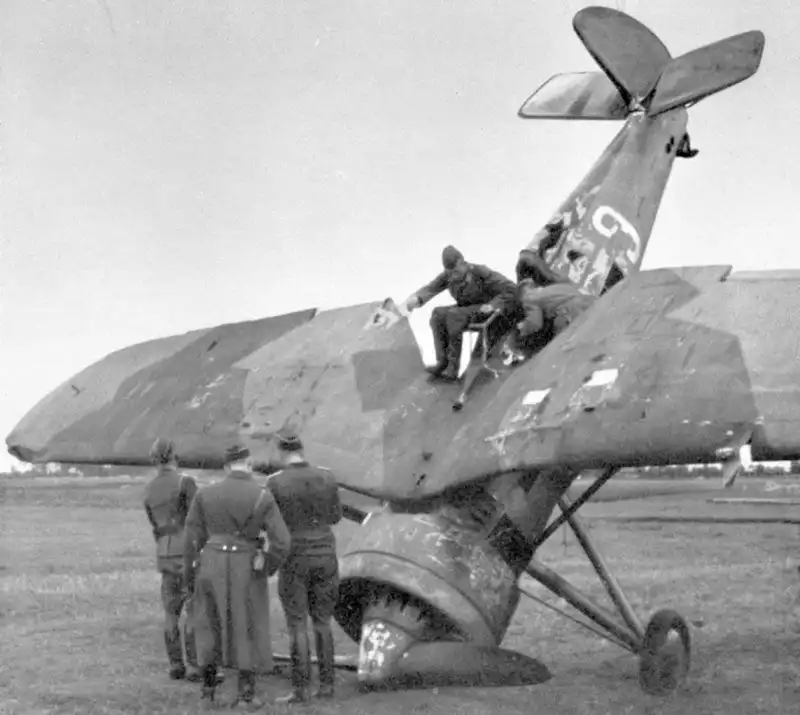
Captured Polish PZL P.11c Fighter at Okęcie Airfield:
This fascinating photograph, taken in September 1939 during the Invasion of Poland, depicts German Wehrmacht soldiers curiously inspecting a force-landed Polish Air Force PZL P.11c fighter aircraft belonging to the 114th Fighter Squadron (114. Eskadra Myśliwska, Pursuit Brigade) at Okęcie airfield near Warsaw.
While the aircraft displays the iconic gull-wing profile designed by Zygmunt Puławski, the photograph contains several unique technical details and evidence of period photographic alteration.
Peculiarities of the Forced Landing and Undamaged Propeller:
A technical examination of the crash site provides clear clues about the final moments of the Polish fighter's flight:
- Undamaged Propeller Blades: The two-blade wooden or metal propeller shows no bending or destruction. This confirms that the pilot turned off the Bristol Mercury radial engine prior to impact, or executed a dead-stick emergency landing after running out of fuel or sustaining combat damage.
- Airframe Position: The aircraft rests nose-down in a typical ground-loop / nose-over stance, a common occurrence during rough-field forced landings on unpaved Polish airfields.
- Squadron Identification: Tactical number "9" and unit insignia on the fuselage identify the fighter as part of the air defenses assigned to protect the capital city of Warsaw during the opening weeks of World War II.
Wartime Photo Retouching and Altered Tail Assembly:
An extraordinary feature of this specific image is the obvious presence of period photo retouching. The vertical stabilizer, rudder, and horizontal tailplanes have been manually drawn over the original photograph using ink or tempera paint:
- Perspective Mismatch: The painted tail section sits at an unnatural angle relative to the axis of the upper fuselage longerons, failing to match the aircraft's true spatial perspective.
- Propaganda Purpose: Period newspaper editors or publishing houses frequently touched up damaged trophy photos to present a complete, aesthetically balanced image of captured enemy hardware for wartime magazines or propaganda postcards.
This image serves as both a historical record of the 1939 Polish Campaign and a striking example of early wartime photographic manipulation.
📍 Location: Okęcie Airfield, Warsaw, Poland
📅 Date: September 1939
📷 Photographer: Unknown (German Army / Press Reporter)
Recommended reading:
- Combat deployment of the PZL P.11c fighter in the September 1939 Campaign
- History and air victories of the Polish 114th Fighter Squadron (114. Eskadra Myśliwska)
- The defense of Warsaw and operations at Okęcie Airfield in 1939
- Techniques of photo manipulation and retouching in WWII military journalism