A rare photograph of a crashed German Heinkel He 111 H-8 bomber fitted with an anti-barrage balloon Kutonase cable-cutting frame in England, Battle of Britain era.
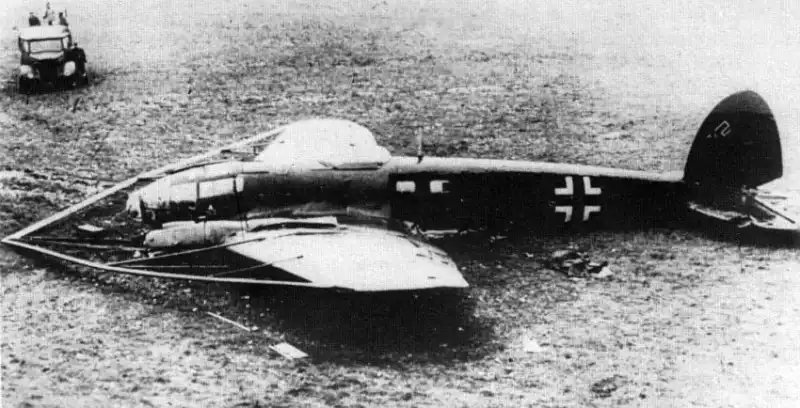
Crashed Heinkel He 111 H-8: The Anti-Barrage Balloon Bomber:
This remarkable photograph captures a shot-down German Heinkel He 111 H-8 medium bomber belly-landed in a countryside field in Great Britain during the intense air campaigns of the Battle of Britain and The Blitz (1940–1941).
What makes this specific crash site extraordinary is the presence of a massive, heavy triangular steel structure mounted directly over the nose and leading edges of the wings—a specialized device designed to breach British urban air defenses.
The "Kutonase" Balloon Cable Cutter System:
To defend critical industrial centers, ports, and cities like London, the British Royal Air Force deployed thousands of barrage balloons anchored by high-tensile steel cables. Flying into these invisible wire grids at night was lethal, as the cables would instantly sever a bomber's wings or propellers.
In response, Luftwaffe engineers developed the specialized Heinkel He 111 H-8 variant equipped with the Kutonase (cable-cutting) frame:
- Massive Structural Weight: The heavy steel tubing and internal framework added roughly 550 to 600 lbs (250–270 kg) of dead weight to the front of the aircraft.
- Cable Guide and Cutters: The frame was designed to deflect incoming balloon cables away from the propellers and engine nacelles, guiding them toward explosive or mechanical cutters located at the outer tips of the V-shaped rig.
- Tail Counterweights: To compensate for the severe nose-heavy balance, ballast weights had to be installed in the rear fuselage section.
Aerodynamic Nightmare and Combat Failure:
While theoretically effective at severing steel mooring cables, German pilots found the He 111 H-8 extremely dangerous to fly. The massive external frame created severe aerodynamic drag, reducing maximum airspeed by up to 25 mph (40 km/h) and drastically degrading maneuverability.
Furthermore, when a cable was struck at high speed, the violent mechanical impact often ripped the aircraft out of controlled flight, sending it into an unrecoverable spin. Due to these dangerous flight characteristics, most surviving H-8 airframes had their Kutonase frames removed and were converted back to conventional bombers or night-glider tugs.
📍 Location: United Kingdom
📅 Date: c. 1940–1941
📷 Photographer: Unknown (British Official / Press Photographer)
Recommended reading:
- Technical design and deployment of the Luftwaffe Heinkel He 111 H-series
- The British RAF Barrage Balloon Command and urban air defense grid
- Luftwaffe counter-measures against cable defenses (Kutonase devices)
- Analysis of German bomber casualties during The Blitz (1940–1941)