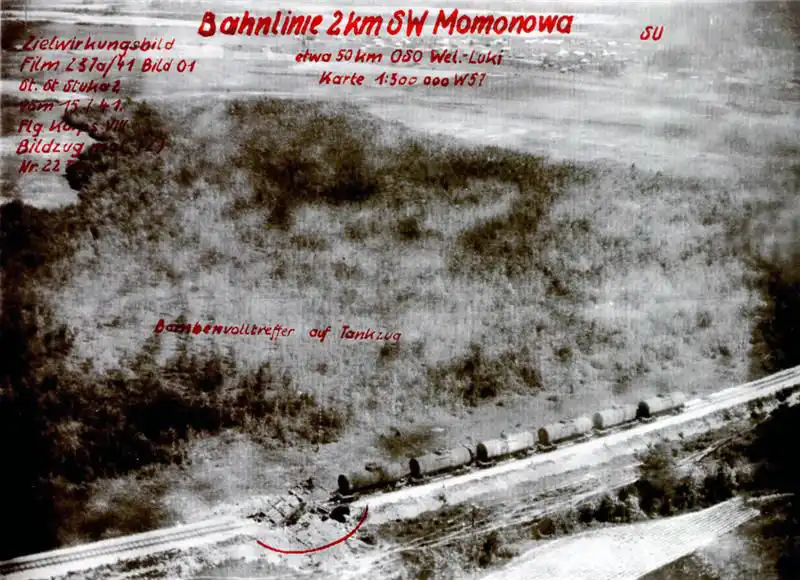
A German aerial photo shows the aftermath of a Stuka strike on a Soviet fuel train, July 1941. A stark image of destruction during the early Eastern Front campaign.
War Seen from Above:
This German aerial reconnaissance photograph shows the aftermath of an airstrike on a Soviet railway fuel train on July 15, 1941, in the Pskov region.
From above, the scene appears almost abstract:
- Twisted railcars
- Scattered debris
- Darkened impact points
But what we are looking at is a direct hit on a vital supply line.
“Direct Hit”:
The original German caption on the image states:
“Direct hit on a fuel tank.”
That short phrase carries enormous weight.
A single bomb striking a fuel wagon would result in:
- Immediate explosion
- Fire spreading across the train
- Destruction of multiple cars
Fuel trains were highly vulnerable — and devastating when hit.
The Aircraft – Junkers Ju 87:
The attack was carried out by Junkers Ju 87 dive bombers, commonly known as Stukas.
These aircraft were designed for precision strikes:
- Steep dive angles for accurate bombing
- Sirens ("Jericho Trumpets") used for psychological impact
- Ability to hit small, specific targets
In the early stages of the war, Stukas were extremely effective against:
- Bridges
- Convoys
- Railway infrastructure
The Importance of Railways:
Rail transport was critical for the Soviet war effort.
Trains carried:
- Fuel
- Ammunition
- Troops
- Equipment
Destroying a single train could disrupt entire supply chains.
A fuel convoy, in particular, was a high-value target:
👉 No fuel → no mobility
👉 No mobility → weakened front
Operation Barbarossa Context:
This strike took place during the early phase of Operation Barbarossa, launched in June 1941.
At this stage:
- German forces were advancing rapidly
- Soviet defenses were disorganized
- Air superiority often belonged to the Luftwaffe
Air power played a crucial role in disrupting Soviet logistics and slowing attempts to regroup.
The Clinical Nature of Destruction:
What makes this photograph particularly striking is its tone.
There are no visible people.
No immediate signs of suffering.
Only:
- Damage
- Geometry of destruction
- Evidence of impact
From the air, war becomes impersonal.
Targets replace people.
Results replace stories.
A Hidden Human Cost:
Yet behind this image lies a human reality:
- Train crews
- Railway workers
- Military personnel
A direct hit on a fuel train would almost certainly result in:
- Heavy casualties
- Severe burns
- Immediate chaos
None of that is visible here — but all of it is present.
The Role of Aerial Photography:
Photographs like this were used for:
- Reconnaissance and intelligence
- Assessing strike effectiveness
- Planning future attacks
They were not meant to evoke emotion.
They were meant to answer one question:
Was the target destroyed?
Historical Photograph Information:
Location: Pskov region, USSR
Date: July 15, 1941
Photographer: Unknown
Recommended Books on Air War and the Eastern Front:
1. Stuka Pilot — Hans-Ulrich Rudel
2. The Luftwaffe War Diaries — Cajus Bekker
3. Barbarossa 1941 — David Stahel
4. Russia at War 1941–1945 — Alexander Werth