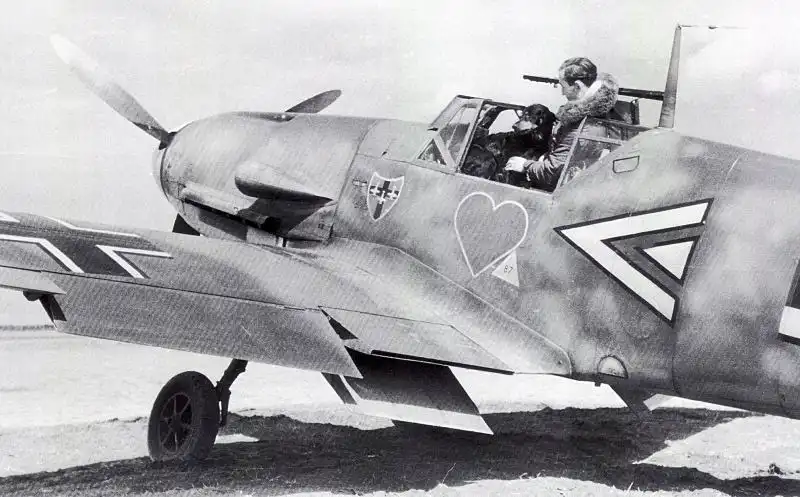
Luftwaffe officer Reinhard Seiler sits in the cockpit of his Bf 109F-4, May 1942. A rare image capturing a fighter pilot on the Eastern Front during World War II.
A Moment Before Takeoff:
This photograph captures Luftwaffe officer Reinhard Seiler sitting in the cockpit of his Messerschmitt Bf 109F-4 in May 1942, at the Siverskaya airfield near Leningrad.
It is a quiet moment — no explosions, no visible combat.
But this silence is deceptive.
Within minutes, the pilot could be in a deadly air battle over the Eastern Front.
The Pilot – Reinhard Seiler:
Reinhard Seiler served as the commander of III Group of Jagdgeschwader 54 (III./JG 54), one of the most active German fighter units on the Eastern Front.
JG 54, also known as the "Green Hearts" (Grünherz), operated extensively in the northern sector:
- Leningrad region
- Baltic territories
- Soviet rear areas
As a Gruppenkommandeur, Seiler was not just a pilot — he was responsible for:
- Leading combat operations
- Coordinating missions
- Managing pilots and aircraft readiness
The Aircraft – Messerschmitt Bf 109F-4:
The aircraft in the image is a Messerschmitt Bf 109F-4, one of the most refined variants of the famous Bf 109 series.
Key features of the F-4 version:
- Improved aerodynamics compared to earlier models
- Excellent maneuverability
- A powerful 20 mm cannon mounted through the propeller hub
- High performance at medium altitudes
Pilots often considered the "Friedrich" (F-series) one of the best-balanced versions of the Bf 109.
The Eastern Front Air War:
By May 1942, the air war over the Soviet Union was intense and relentless.
German fighter units like JG 54 were engaged in:
- Air superiority missions
- Escorting bombers
- Intercepting Soviet aircraft
- Ground attack operations
The Eastern Front differed from the Western Front in several ways:
- Vast distances
- Harsh weather conditions
- Constant operational pressure
Pilots often flew multiple sorties per day under exhausting conditions.
Siverskaya Airfield:
The photograph was taken at Siverskaya airfield, located near Leningrad.
This region was a critical front:
- The city of Leningrad was under siege
- Soviet forces were attempting to break encirclement
- German forces aimed to maintain pressure and control the air
Airfields like Siverskaya were essential hubs for:
- Refueling and rearming
- Aircraft maintenance
- Rapid deployment of fighter units
A Pilot's Reality:
This image captures a rare personal moment in a pilot's life.
Inside the cockpit:
- Instruments surround him
- Controls are within arm's reach
- The machine is ready
But beyond that cockpit lies:
- A sky filled with danger
- Enemy fighters
- Anti-aircraft fire
- The constant risk of death
For many pilots, survival depended on skill, luck, and experience.
Between Routine and Death:
What makes this photograph powerful is its stillness.
It represents the thin line between:
- Routine preparation
- Immediate combat
A pilot sitting calmly in a cockpit might, within minutes:
- Engage in a dogfight
- Be shot down
- Or return safely
War, especially air war, often shifted in seconds.
Historical Photograph Information:
Location: Siverskaya airfield, Leningrad region, USSR
Date: May 1942
Photographer: Unknown
Recommended Books on the Luftwaffe and Air War:
1. The Luftwaffe War Diaries — Cajus Bekker
2. JG 54: The Grünherz Fighter Wing — John Weal
3. Fighter Aces of the Eastern Front — Mike Spick
4. The German Fighter Pilot Experience — Johannes Steinhoff