French infantrymen carefully inspect the charred remains of a German Heinkel He 111 medium bomber shot down during the Battle of France in May 1940.
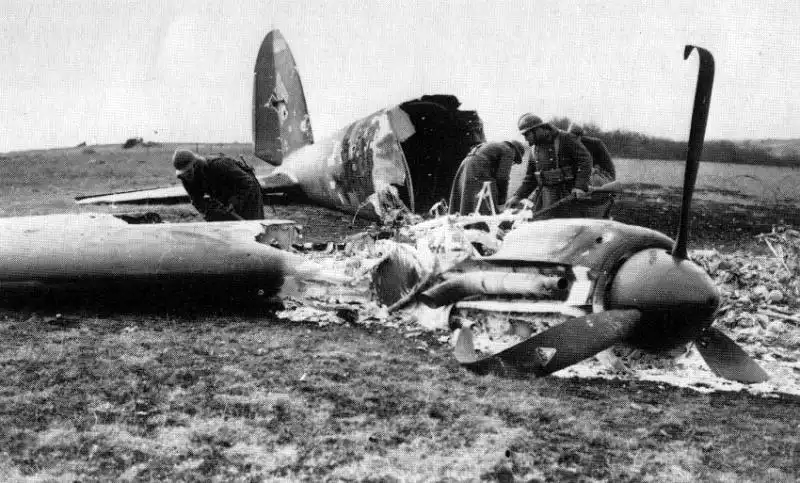
French Troops Examining Downed Heinkel He 111 Wreckage:
This dramatic photograph from May 1940 shows French infantrymen wearing iconic Adrian helmets carefully inspecting the shattered, burnt-out wreckage of a German Heinkel He 111 medium bomber. The aircraft was brought down over French territory during the opening stages of the Battle of France (Campagne de France).
The force of the crash and subsequent fire destroyed the central fuselage, severing the tail section from the rest of the airframe. The bent propeller blades on the right Jumo/Daimler-Benz engine indicate that the bomber hit the ground while its propellers were still spinning under power during a forced belly landing.
The Air War Over France in Spring 1940:
During the blitzkrieg offensive launched on May 10, 1940, the Luftwaffe deployed hundreds of Heinkel He 111 bombers to strike French airfields, troop concentrations, and logistical hubs. However, Allied anti-aircraft artillery and resilient fighter units (flying fighters like the Dewoitine D.520 and Morane-Saulnier MS.406) exacted a heavy toll on German bomber formations.
In the first weeks of the campaign, hundreds of German aircraft were shot down behind French lines, providing Allied intelligence with valuable opportunities to examine enemy technology.
Intelligence Gathering and Crash Site Procedures:
When an enemy aircraft crashed, local French ground troops were instructed to secure the site immediately. Soldiers searched the wreckage for vital intelligence materials, including:
- Flight Logs and Maps: To determine the targets, base locations, and navigation routes of the Luftwaffe bomber wing (Kampfgeschwader).
- Radio Equipment and Codebooks: Key elements for Allied military intelligence to decipher tactical Luftwaffe transmissions.
- Aircrew Identification: Documenting captured or deceased aircrew members to account for enemy personnel strength.
Photographs like this capture a rare moment of triumph for French ground forces during a period otherwise marked by rapid strategic collapse and intense military crisis.
📍 Location: Northern France
📅 Date: May–June 1940
📷 Photographer: Unknown
Recommended reading:
- Luftwaffe bomber losses during the Battle of France (1940)
- Design and operational history of the Heinkel He 111 medium bomber
- French Army infantry equipment and the Adrian helmet (Casque Adrian)
- Allied crash site investigation and military intelligence gathering in WWII