The story behind a knocked-out US M4A3 Sherman tank named "GALLERO", featuring unique Hispanic crew artwork, disabled during the Battle of the Bulge in Belgium.
The Story of the M4A3 Sherman "GALLERO" in the Ardennes:
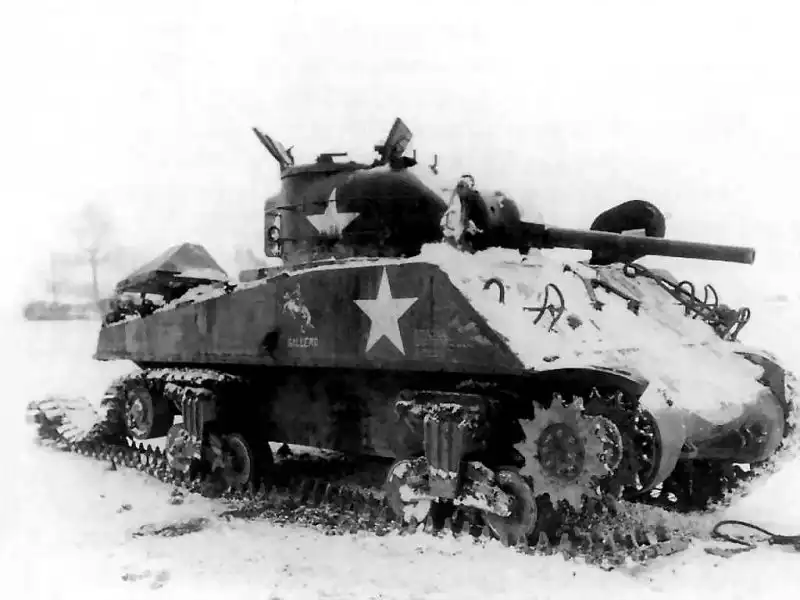
This striking photograph from the winter of 1944–1945 captures a knocked-out American M4A3 (75)W Sherman medium tank sitting stranded in the deep snow of Belgium during the Battle of the Bulge. The aircraft and armor preserved in this image display a rare and highly personalized piece of tank artwork on its right hull side.
Emblazoned on the armor plate is a custom insignia: an aggressive fighting rooster standing in a combative pose, accompanied by the name "GALLERO" (Spanish for "cockfighter" or a breeder of gamecocks). A clear penetration hole from a German armor-piercing anti-tank shell is visible directly beneath and to the left of the rooster emblem, which ultimately disabled the tank and threw its tracks.
The "G" Company Naming Convention and Hispanic Tankers:
The US Army Armored Force followed a strict naming tradition where tanks within a specific company were given nicknames starting with the letter of that company. The name "GALLERO" indicates that this M4A3 belonged to Company "G" (Golf Company) of an American armored regiment or independent tank battalion operating in the Ardennes theater.
The choice of a Spanish name and the aggressive gamecock artwork strongly points to a Mexican-American or Hispanic tank crew hailing from states like Texas, New Mexico, or California. Thousands of Hispanic-American soldiers served with distinction in armored formations across Western Europe, bringing their local culture, language, and personal symbols directly to the frontlines.
Battle Damage and Abandonment in the Snow:
During the heavy winter combat of December 1944 and January 1945, US armored units faced severe challenges fighting German heavy armor and anti-tank gun concealed in the dense Ardennes forests. The photograph reveals the harsh realities of armored warfare:
- Point of Penetration: The high-velocity German anti-tank round penetrated the upper hull side armor, likely igniting an internal fire or destroying vital internal mechanical components.
- Mobility Kill: The right track has been completely severed and thrown off the suspension bogies, immobilizing the vehicle in the snow.
- Hatches Thrown Open: Both the driver's and commander's hatches remain wide open, suggesting that at least part of the crew was able to evacuate the burning vehicle following the catastrophic strike.
Personalized insignia like "GALLERO" are exceptionally rare in official US Army photographic archives, making this image a valuable historical record of individual crew identity amidst the brutal battle for Europe.
📍 Location: Ardennes Region, Belgium
📅 Date: Winter 1944–1945
📷 Photographer: Unknown (US Army Signal Corps)
Recommended reading:
- Hispanic-American soldiers and armored crews in World War II
- US Army tank naming conventions and informal hull artwork
- Tactical combat operations of US Armored Divisions during the Battle of the Bulge
- Armor penetration characteristics of German anti-tank guns against the M4A3 Sherman