Archival photograph taken on July 29, 1942, showing the destroyed No. 1 armored gun turret of the 35th Coastal Artillery Battery and a wrecked GAZ-AA truck at Cape Khersones, Sevastopol.
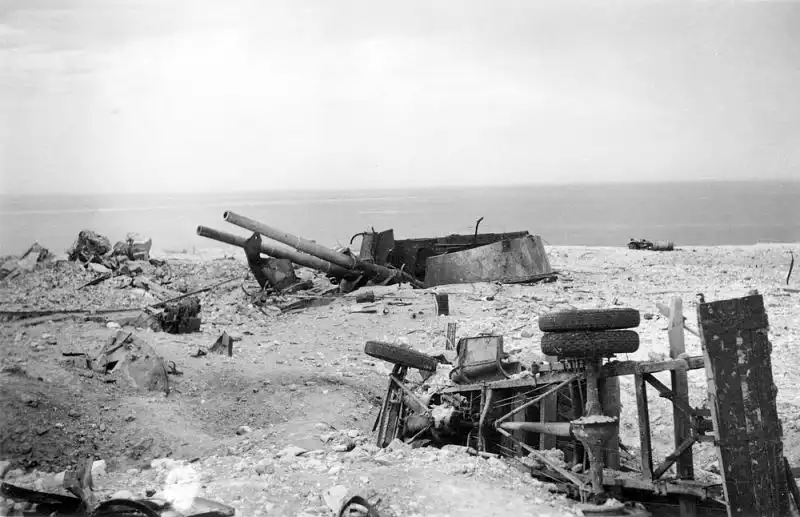
Destroyed Turret No. 1 of the 35th Coastal Battery in Sevastopol (July 1942)
This heavy historical photograph, recorded on July 29, 1942, documents the catastrophic aftermath of the final battles for Sevastopol at Cape Khersones. In the center of the image lies the shattered armored turret installation No. 1 (BB-1) of the famous Soviet 35th Coastal Artillery Battery (designated by German intelligence as Fort Maxim Gorki II), equipped with twin 305 mm (12-inch) naval guns. In the foreground, the destroyed chassis of a Soviet GAZ-AA / GAZ-MM light cargo truck lies overturned near the artillery blast crater.
Alongside Battery No. 30, the 35th Coastal Battery formed the backbone of the Sevastopol Fortress artillery defense system, firing thousands of heavy-caliber high-explosive shells against advancing Axis troops throughout the 250-day siege.
Technical Details: MB-2-12 Gun Turret and Scuttling Operations
The visual condition of the installation highlights the deliberate destruction of the position by its crew prior to total encirclement:
- Twin 305 mm Gun Turret (MB-2-12): Designed to withstand heavy air bombardment and counter-battery fire, the heavily armored turret housed two 305 mm L/52 guns capable of hitting targets up to 40 kilometers away.
- Final Direct-Fire Engagement: On July 1, 1942, after completely exhausting long-range high-explosive ammo reserves, Battery Commander Captain A. J. Leshchenko ordered the battery's final six practice/shrapnel rounds fired point-blank at advancing German infantry units closing in on Cape Khersones.
- Controlled Demolition: On the night of July 1–2, 1942, following orders from the Sevastopol Defense Zone command, engineering personnel detonated internal magazine powder charges inside the main concrete artblock. The massive internal explosion displaced the armored turret from its barbette ring and destroyed the main barrel mechanisms to prevent capture.
- GAZ-AA / GAZ-MM Wreckage: The overturned truck frame visible in the foreground illustrates the intense artillery fire that swept the open terrain of Cape Khersones, where supply vehicles transported ammunition and evacuated wounded personnel to waiting rescue submarines.
The Fall of Sevastopol and Cape Khersones
The destruction of the 35th Battery marked the operational end of organized Soviet defense in the Crimea during 1942:
- Final Red Army Stand: Deprived of air cover and coastal artillery support, tens of thousands of Soviet defenders made their final stand along the rocky coastline surrounding the 35th Battery complex until July 4, 1942.
- Memorial Complex: Today, the preserved ruins of the artillery blocks and underground casemates form the central exhibit of the Museum Historic Memorial Complex "35th Coastal Battery" in Sevastopol.
📍 Location: Cape Khersones, Sevastopol, Crimea, USSR
📅 Date: July 29, 1942
📷 Photographer: Unknown (German Army / Propaganda Company Photo Archive)
📰 Primary Source: Sevastopol Defense Archives / Central Naval Museum Records
Recommended reading:
- Technical design and combat history of the 35th Coastal Battery (Fort Maxim Gorki II)
- 305 mm twin-gun turret installations: MB-2-12 naval artillery systems
- The final defense of Cape Khersones and the fall of Sevastopol (July 1942)
- Logistics and field vehicles: GAZ-AA and GAZ-MM trucks in the Crimean Campaign