Destroyed German Panzer III Ausf. M near Ponyri during the Battle of Kursk, July 1943.
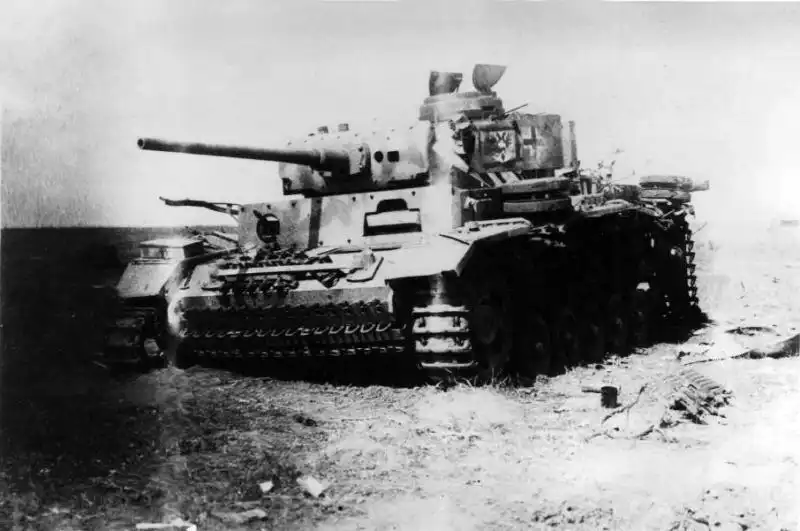
This photograph shows a destroyed German Pz.Kpfw. III Ausf. M medium tank from the 3rd Tank Regiment of the 2nd Panzer Division, knocked out by Red Army forces near the village of Ponyri during the decisive Battle of Kursk. The image dates to 12–15 July 1943, when some of the fiercest fighting in the northern sector of the Kursk salient took place.
Once the backbone of Germany’s Blitzkrieg campaigns, the Panzer III was one of the most important tanks of the early Wehrmacht armored formations. Designed to fight enemy armored vehicles and support rapid advances, it played a central role during the campaigns in Poland, France, and the opening stages of Operation Barbarossa. However, by 1943 the battlefield had changed dramatically, and the vehicle faced increasingly serious challenges from newer Soviet tanks.
The designation Ausf. is an abbreviation of the German word Ausführung, meaning a model, version, or variant. The Ausf. M represented one of the later production versions of the Panzer III and included improvements such as additional armor protection, a deep-wading capability, and the longer 5 cm KwK 39 L/60 gun. Despite these upgrades, the tank’s combat potential was becoming limited against heavily armored Soviet vehicles.
By the summer of 1943, the Panzer III was increasingly outclassed by Soviet tanks such as the T-34 and KV series. Its 50 mm KwK 39 L/60 gun could defeat many earlier armored vehicles, but struggled against newer Soviet designs at typical combat distances. During the Battle of Kursk, where Soviet defenses were carefully prepared with minefields, anti-tank guns, artillery positions, and reserve forces, Panzer III units suffered heavy losses.
Ponyri – the "Little Stalingrad" of the Battle of Kursk
The village of Ponyri became one of the most heavily contested areas of the northern Kursk salient. German forces launched repeated attacks in an attempt to break through the Soviet defensive lines, turning the area around the railway station and surrounding villages into a battlefield of constant artillery fire, infantry assaults, and armored clashes.
The intensity of the fighting led Soviet and German veterans to later describe Ponyri as the “Little Stalingrad” of the Kursk campaign. Unlike the southern sector near Prokhorovka, where large tank formations famously clashed, the fighting around Ponyri was characterized by fortified defensive positions, carefully coordinated anti-tank warfare, and brutal close-range combat.
The destroyed Panzer III in this photograph represents the difficulties faced by German armored units during Operation Citadel. Vehicles that had once enabled rapid victories across Europe were now forced to attack deeply prepared Soviet defenses while facing increasingly capable enemy weapons.
The Battle of Kursk marked a major turning point on the Eastern Front. After the failure of the German offensive, the strategic initiative permanently shifted toward the Red Army, while Germany increasingly relied on defensive operations and improved armored designs such as the Panther and Tiger tanks.
Captured by photographer G. Petrov, this image stands as a stark reminder of the attritional nature of the Battle of Kursk, where thousands of men and hundreds of armored vehicles were lost in one of the largest battles in military history.
Technical Photo Data:
📍 Location: Ponyri, Kursk region, USSR
📅 Date: 12–15 July 1943
📝 Subject: Destroyed German Pz.Kpfw. III Ausf. M, 2nd Panzer Division
📷 Photographer: G. Petrov