A battle-damaged Soviet Maxim machine gun abandoned during the dramatic opening months of the German invasion of the Soviet Union.
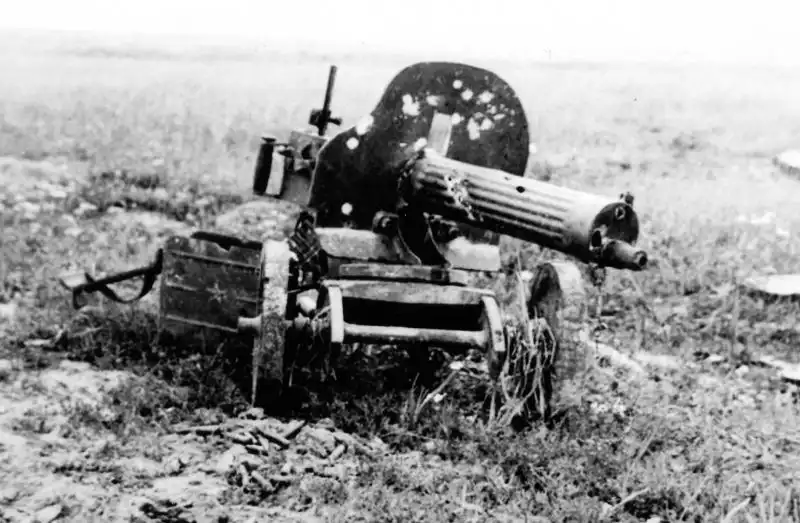
This atmospheric photograph shows a heavily damaged Soviet Maxim M1910/30 heavy machine gun abandoned somewhere on the Eastern Front during the summer of 1941.
Unlike many wartime images, this one offers almost no information about the battle itself. Instead, it invites the viewer to reconstruct the events by carefully examining the details left behind.
Reading the Battlefield:
Several features immediately attract attention.
Only a relatively small number of spent cartridge cases lie in front of the gun, suggesting that the weapon may not have fired for very long before being put out of action.
The machine gun still contains a partially expended ammunition belt, indicating that the crew had no opportunity—or no time—to remove it before leaving the position.
Even more striking are the numerous bullet impacts visible on both the armored gun shield and the water-cooling jacket surrounding the barrel. These scars testify to concentrated enemy fire directed specifically at the weapon.
An Improvised Position:
Equally noteworthy is what cannot be seen.
There are no prepared trenches, sandbags, log emplacements, or other field fortifications around the machine gun. Likewise, no bodies are visible near the position.
This suggests that the Maxim may have been deployed hastily, perhaps to delay an advancing enemy or cover the withdrawal of other Soviet troops during the chaotic fighting of the opening weeks of Operation Barbarossa.
However, the photograph alone cannot reveal exactly what happened, and any reconstruction must remain speculative.
The Maxim Machine Gun:
The Maxim M1910/30 was the principal heavy machine gun of the Red Army during the early years of the Second World War.
Its water-cooled barrel allowed prolonged periods of sustained fire, making it particularly effective in defensive positions.
Mounted on the characteristic Sokolov wheeled carriage with an armored shield, the weapon was rugged and dependable but also heavy. Under favorable conditions, an experienced crew could keep it firing almost continuously, provided sufficient ammunition and water were available.
A Silent Witness:
What makes this photograph so compelling is precisely the absence of certainty.
No report survives to explain why the machine gun was abandoned. No surviving caption identifies the unit or the battle.
Instead, the damaged weapon remains as a silent witness to one of countless small engagements fought across the Soviet Union during the summer of 1941—actions that often lasted only minutes but determined the fate of the men involved.
The unanswered questions give the photograph much of its enduring historical power.
📍 Location: USSR
📅 Date: Summer 1941
📷 Photographer: Unknown
Recommended Reading:
- Chris McNab — Weapons of the Russian Army 1914–1945
- David Glantz — Barbarossa: Hitler's Invasion of Russia 1941
- John Ellis — The World War II Databook
- Steven J. Zaloga & James Grandsen — Soviet Tanks and Combat Vehicles of World War Two
- David Stahel — Operation Barbarossa and Germany's Defeat in the East
- Alexey Isaev — Dubno 1941: The Greatest Tank Battle of the Second World War