American soldiers operate a Browning M1917A1 heavy machine gun during military exercises in Louisiana before deployment overseas.
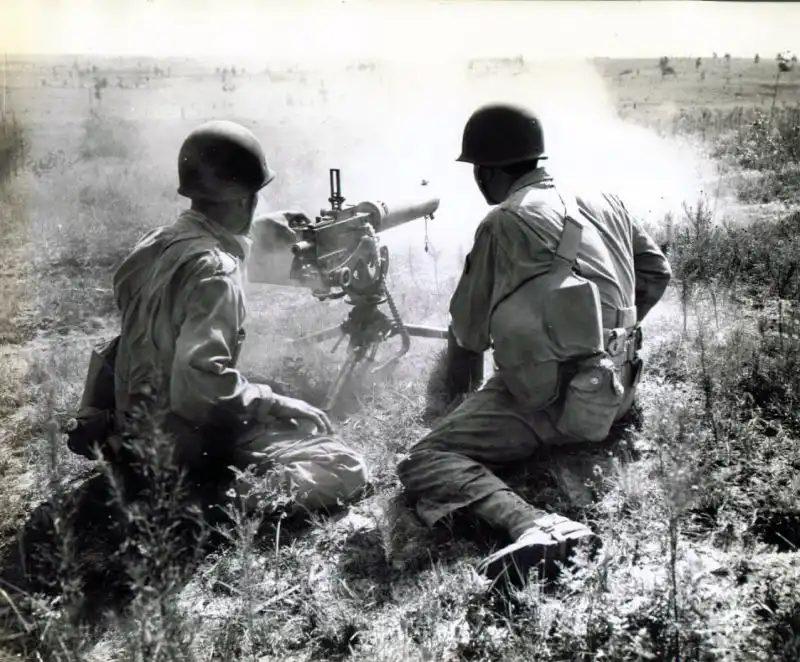
This photograph shows an American machine gun crew operating the 7.62 mm Browning M1917A1 water-cooled heavy machine gun during military exercises in the state of Louisiana in 1942.
Long before American troops fought in North Africa, Europe, or the Pacific, thousands of soldiers trained in large-scale field maneuvers across the southern United States. These exercises helped transform the U.S. Army from a relatively small peacetime force into one capable of conducting modern combined-arms warfare.
The Louisiana Maneuvers:
The Louisiana Maneuvers were among the largest military exercises ever conducted in the United States.
Hundreds of thousands of troops participated in simulated combat operations that tested tactics, logistics, command structures, and new equipment under realistic field conditions.
The lessons learned during these exercises influenced American battlefield doctrine throughout the Second World War, and many officers who later commanded troops in Europe and the Pacific gained valuable experience during these maneuvers.
The Browning M1917A1:
The Browning M1917A1 was one of the most reliable heavy machine guns used by the U.S. Army.
Designed by John Moses Browning, it employed a water-cooled barrel, allowing it to sustain prolonged fire without overheating. Mounted on a tripod, the weapon provided continuous suppressive fire against infantry attacks and defended fixed positions.
Following America's entry into World War II, demand for machine guns increased dramatically. Large-scale production of the M1917A1 began in 1942 to equip the rapidly expanding U.S. Army.
Wartime Improvements:
Combat experience led to several modifications during wartime production.
The original bronze water jacket was gradually replaced with a more economical steel version, reducing manufacturing costs while conserving strategic materials. The sights were recalibrated for the standard M2 Ball cartridge, and many guns received the M8 conical flash suppressor, designed to reduce the highly visible muzzle flash produced during night firing.
Although the flash suppressor improved concealment, the weapon's distinctive firing sound remained impossible to hide.
It is difficult to determine from this photograph whether the machine gun still retains the earlier bronze water jacket or the later wartime steel version.
A Weapon Produced in Enormous Numbers:
American industry manufactured 53,854 Browning M1917A1 heavy machine guns during the Second World War.
At the same time, production of air-cooled Browning machine guns—including infantry, tank, aircraft, and vehicle-mounted variants—reached approximately 729,000 units between 1940 and 1945.
These extraordinary production figures illustrate the industrial capacity that enabled the United States to equip not only its own armed forces but also numerous Allied nations.
Preparing for a Global War:
Although no combat is visible, this photograph captures an important stage in the American war effort.
Every crew that trained on weapons such as the Browning M1917A1 represented future combat units that would eventually serve in North Africa, Italy, France, Germany, and across the Pacific.
The image reflects the intensive preparation that preceded America's full-scale participation in World War II.
📍 Location: Louisiana, United States
📅 Date: 1942
📷 Photographer: Unknown
Recommended Reading:
- Ian V. Hogg — The Guns 1939–1945
- Frank Iannamico — United States Browning Machine Guns
- R. P. Hunnicutt — American Infantry Weapons of World War II
- Shelby L. Stanton — U.S. Army Uniforms of World War II
- Williamson Murray & Allan R. Millett — A War to Be Won
- Stephen E. Ambrose — Citizen Soldiers