Iconic 1945 photograph by Yevgeny Khaldei showing the wreckage of a Luftwaffe DFS 230 transport glider lodged in an apartment building on Attila Street during the Siege of Budapest.
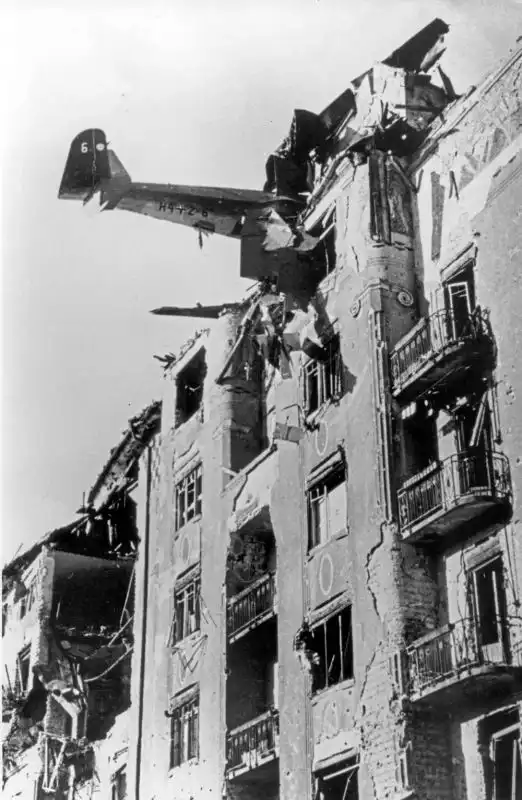
Crashed German DFS 230 Glider in a Budapest Apartment Building (February 1945)
This striking and iconic photograph taken in February 1945 by famous Soviet war photojournalist Yevgeny Khaldei records one of the most surreal images of urban combat during World War II: the wreckage of a German DFS 230 assault glider embedded in the upper facade of a residential apartment building on Attila Street (Attila út 35/37) in Budapest, Hungary.
Piloted by Feldwebel Georg Filius, the glider crashed on February 4, 1945, during a hazardous night resupply mission aimed at delivering critical ammunition and food rations to encircled German and Hungarian troops defending the Buda pocket. The pilot was killed instantly upon impact.
Equipment, Uniforms, and Visual Features
The image offers remarkable structural detail regarding German airborne equipment and the sheer intensity of urban destruction during the Siege of Budapest:
- DFS 230 Glider Airframe: The rear fuselage, tail assembly, and fabric-covered steel-tube framing of the DFS 230 military transport glider are suspended precariously from the fourth-floor masonry wall.
- Luftwaffe Tactical Markings: Military registration codes (H4+2-6) and the Luftwaffe national cross (Balkenkreuz) remain clearly visible on the side of the fuselage section sticking out over the street.
- Impact and Structural Damage: The heavy momentum of the glider tore open the upper brickwork, collapsing internal ceilings and leaving interior rooms exposed to the elements alongside shattered iron balcony railings.
- Airlift Resupply Context: With all airfields captured by advancing Red Army forces, the German command resorted to landing gliders on Vérmező ("Bloody Meadow"), a narrow park near the Buda Castle, making navigational errors and crash-landings extremely common due to anti-aircraft fire and poor night visibility.
The Battle for the Buda Pocket
During the final weeks of the Siege of Budapest, Luftwaffe transport units attempted dangerous nocturnal glider operations to sustain the surrounded garrison. Facing overwhelming Soviet air superiority and dense anti-aircraft artillery, dozens of gliders were shot down or crashed into dense residential neighborhoods before the Axis garrison finally surrendered on February 13, 1945.
📍 Location: Attila Street (Attila út), Budapest, Hungary
📅 Date: February 1945
📷 Photographer: Yevgeny Khaldei
📰 Primary Source: Soviet State Photographic Archive
Recommended reading:
- Airborne resupply operations: The role of DFS 230 transport gliders in the Siege of Budapest
- Urban combat in Hungary: Street fighting and fortress defense during the Battle of Budapest (1944–1945)
- Masters of photography: The frontline photojournalism of Yevgeny Khaldei
- Battlefield archaeology: War damage and historical architecture along Attila Street in Buda