Historical February 1943 photograph by Emmanuil Evzerikhin showing a Red Army mortar crew preparing 82 mm O-832 fragmentation bombs fitted with bakelite fuzes during the battle for Kursk.
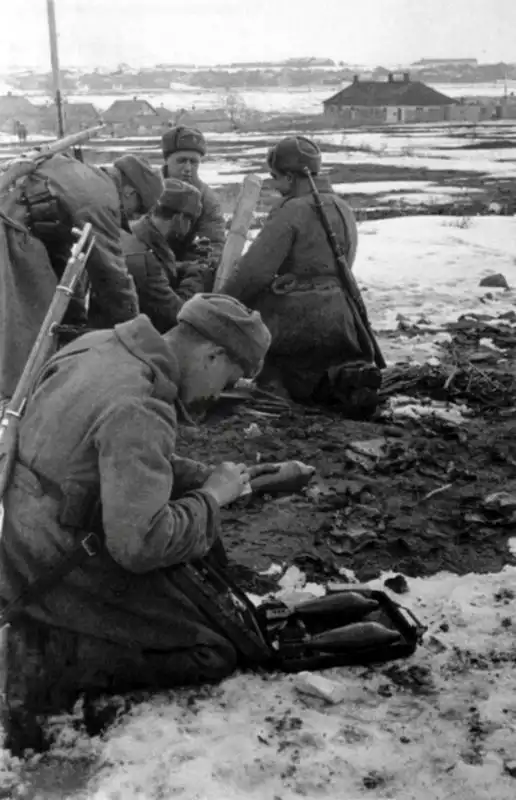
Soviet 82 mm Mortar Crew Firing During the Liberation of Kursk (February 1943)
This detailed archival photograph taken in February 1943 by renowned Soviet photographer Emmanuil Evzerikhin captures a Red Army battalion mortar crew preparing to open fire during the offensive operations to liberate Kursk from German occupation.
Operating an 82 mm battalion mortar (BM-37 or BM-41), the crew is documented handling O-832 six-finned fragmentation mortar bombs fitted with specialized bakelite (plastic) fuzes on the snowy outskirts of the city.
Equipment, Uniforms, and Visual Features
The image provides exceptional insight into tactical mortar crew operations and technical ammunition features used during winter engagements:
- Bakelite Fuze Advantage: The 82 mm O-832 fragmentation rounds depicted in the transit crate feature lightweight bakelite fuzes. Unlike older metal M-1 or M-5 fuzes, these plastic variants eliminated the need to unscrew protective metal safety caps prior to loading, significantly increasing the practical rate of fire during rapid defensive or offensive barrages.
- Ammunition Preparation: A mortarman kneeling in the foreground carefully inspects and prepares the O-832 rounds, attaching incremental propellant charge rings to the tail boom assembly before handing them to the loader.
- Personal Arms and Winter Gear: The crew members are equipped with 7.62 mm Mosin-Nagant M1891/30 bolt-action rifles slung across their backs, standard M1940 winter overcoats, quilted cotton jackets, and earflap fur caps (Ushanka).
- Combat Positioning: The mortar is emplaced in a natural slope cutout to shield the crew from small arms fire and artillery shrapnel while maintaining clear high-angle indirect fire trajectories toward German defensive strongpoints.
The Liberation of Kursk in February 1943
In early February 1943, forces of the Red Army's Voronezh Front, including General Ivan Chernyakhovsky's 60th Army, launched a swift assault to recapture the strategic railway junction of Kursk. Light 82 mm mortar crews provided crucial mobile fire support to advancing infantry squads clearing German fortified positions in urban outskirts and rural hamlets.
📍 Location: Kursk, RSFSR, USSR
📅 Date: February 1943
📷 Photographer: Emmanuil Evzerikhin
📰 Primary Source: Soviet State War Photographic Archive
Recommended reading:
- Light artillery tech: Technical design and ballistics of Soviet 82 mm mortar systems
- WWII ordnance: Evolution of Soviet mortar fuzes and fragmentation bomb designs
- Voronezh Front offensive: Tactical operations during the liberation of Kursk in February 1943
- Masters of photography: Frontline combat reportage of Emmanuil Evzerikhin