A German soldier posing next to a captured Soviet M4 Quad Maxim anti-aircraft machine gun (MG.216(r)) at the Eastern Fort of Brest Fortress, July 1941.
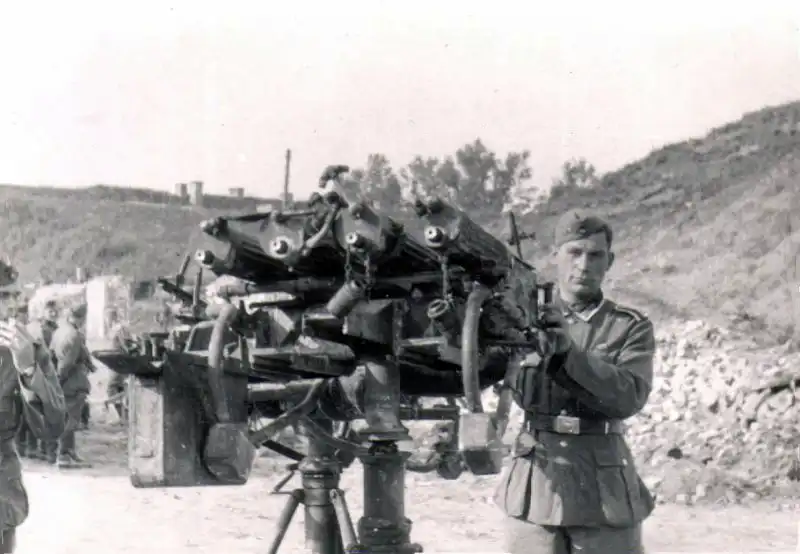
Captured Soviet M4 Quad Maxim AA Mount at the Eastern Fort of Brest Fortress:
This striking historical photograph captures a German soldier posing beside a captured Soviet M4 Quad Maxim Anti-Aircraft Machine Gun Mount (Model 1931) following the intense fighting at the Eastern Fort of Brest Fortress in July 1941. Belonging to the Red Army's 393rd Separate Anti-Aircraft Artillery Battalion, this heavy anti-aircraft system played a vital role in defending the Citadel and outer fortifications during the opening phase of Operation Barbarossa.
The photo highlights the complex engineering of the weapon, featuring four 7.62 mm Maxim PM1910 water-cooled barrels mounted on a central tripod pedestal with unified trigger mechanisms and forced water cooling hoses.
The Defense of the Eastern Fort:
The Eastern Fort of the Brest Fortress, situated on the Northern Island (Severny Island), became one of the most resilient strongpoints of Soviet resistance. Command of the fort's defense was taken by Major Pyotr Gavrilov, commander of the 44th Rifle Regiment, who organized a stubborn perimeter defense utilizing infantry, border guards, and anti-aircraft personnel.
The gunners of the 393rd Separate Anti-Aircraft Artillery Battalion utilized their quad-mounted Maxim machine guns not only against low-flying Luftwaffe Junkers Ju 87 dive-bombers, but also as devastating anti-personnel weapons, directing intense volumes of direct fire against advancing German infantry attempting to breach the fort's ramparts.
German Capture and Beutewaffen Designation MG.216(r):
After weeks of relentless artillery bombardment, flamethrower assaults, and heavy air strikes—including the dropping of a massive 1,800 kg SC1800 bomb on the fort—the organized defense of the Eastern Fort was finally broken at the end of June and early July 1941.
Following its capture, the Wehrmacht systematically cataloged captured Red Army ordnance for potential integration into their own rear-area defenses or coastal fortifications. In official German military nomenclature (*Beutewaffen* index), the Soviet M4 Quad Maxim mount was designated as the 7,62 mm Schweres Maschinengewehr 216(r), abbreviated as MG.216(r).
German troops frequently used captured MG.216(r) mounts for airfield protection, anti-partisan security details, and coastal defense emplacements throughout occupied Eastern Europe.
📍 Location: Brest Fortress (Eastern Fort), Byelorussian SSR, USSR
📅 Date: July 1941
📷 Photographer: Unknown
Recommended reading:
- The combat operations of the 393rd Separate Anti-Aircraft Artillery Battalion
- Major Pyotr Gavrilov and the siege of the Eastern Fort (Brest Fortress)
- Technical design of the M4 Quad Maxim (Tokarev) Anti-Aircraft Mount
- German Beutewaffen designations for captured Soviet small arms and crew-served weapons