German soldiers posing with the captured banner of the Soviet NKVD 132nd Escort Battalion in Brest Fortress, summer 1941.
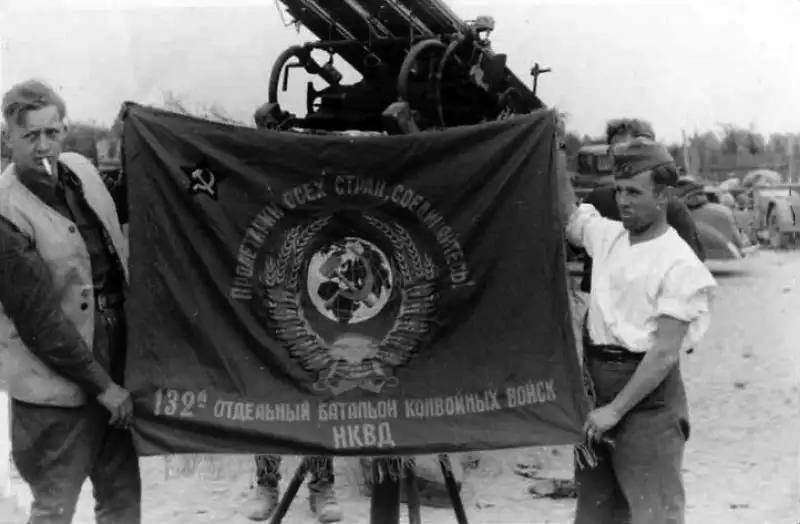
Captured Banner of the NKVD 132nd Escort Battalion in Brest Fortress:
This dramatic photograph, retrieved from a German soldier's personal souvenir album, shows Wehrmacht troops displaying a captured unit banner during the opening phase of Operation Barbarossa in the summer of 1941. The banner belonged to the 132nd Separate Escort Battalion of the NKVD Troops, one of the key Soviet garrison units stationed inside the historical Brest Fortress during the German invasion.
The banner features the classic early-style State Emblem of the Soviet Union (USSR) alongside the iconic slogan "Workers of the world, unite!" and the clear designation of the battalion embroidered across the lower border.
The Heroic Defense of Brest Fortress:
When Nazi Germany launched its surprise attack on the Soviet Union on June 22, 1941, the town of Brest was rapidly bypassed, but the defenders inside the Citadel and surrounding fortifications of the Brest Fortress mounted a legendary, prolonged resistance against the invading German 45th Infantry Division.
Stationed in the central Citadel, soldiers of the 132nd NKVD Battalion fought alongside border guards and Red Army infantry units. Despite facing heavy artillery bombardment, air strikes, and extreme shortages of water, medicine, and ammunition, pockets of Soviet resistance inside the fortress casemates held out for weeks against overwhelming odds.
"I am dying, but I will not surrender!":
The 132nd NKVD Battalion is forever tied to one of the most famous physical testaments of Soviet wartime resilience. Following the heavy fighting, a famous inscription carved into the plaster wall of the 132nd Battalion's barracks was discovered by Soviet forces upon the liberation of Brest:
"I am dying, but I will not surrender! Farewell, Motherland! 20.VII.41"
Dated July 20, 1941—nearly a month after the initial German onslaught—this famous wall inscription stands as enduring proof of the desperate, protracted resistance waged by the surviving defenders hidden deep inside the fortress cellars.
Tokarev Quad Maxim Anti-Aircraft Mount:
Directly behind the captured banner, the photograph captures a Soviet M4 Quad Maxim Anti-Aircraft Gun Mount (Model 1931), designed by N. F. Tokarev. Utilizing four water-cooled 7.62 mm Maxim machine guns mounted on a single motorized or towed tripod base, this weapon provided high-volume anti-aircraft cover against low-flying Luftwaffe strafers and dive-bombers during the opening hours of the defense.
📍 Location: Brest-Litovsk (Brest Fortress), Byelorussian SSR, USSR
📅 Date: Summer 1941
📷 Photographer: Unknown
Recommended reading:
- The combat history of the 132nd Separate Escort Battalion of NKVD Troops
- The defense of Brest Fortress in June–July 1941
- The M4 Quad Maxim (Tokarev) anti-aircraft weapon system
- Captured Soviet military banners and trophies in Wehrmacht photo albums